From Art Project to National Geographic of the Digital Age: The Atlas Obscura Story
894K
Monthly Visitors
$18.7M
Traffic Value/yr
DR 86
Domain Rating
91.3K
Ref. Domains
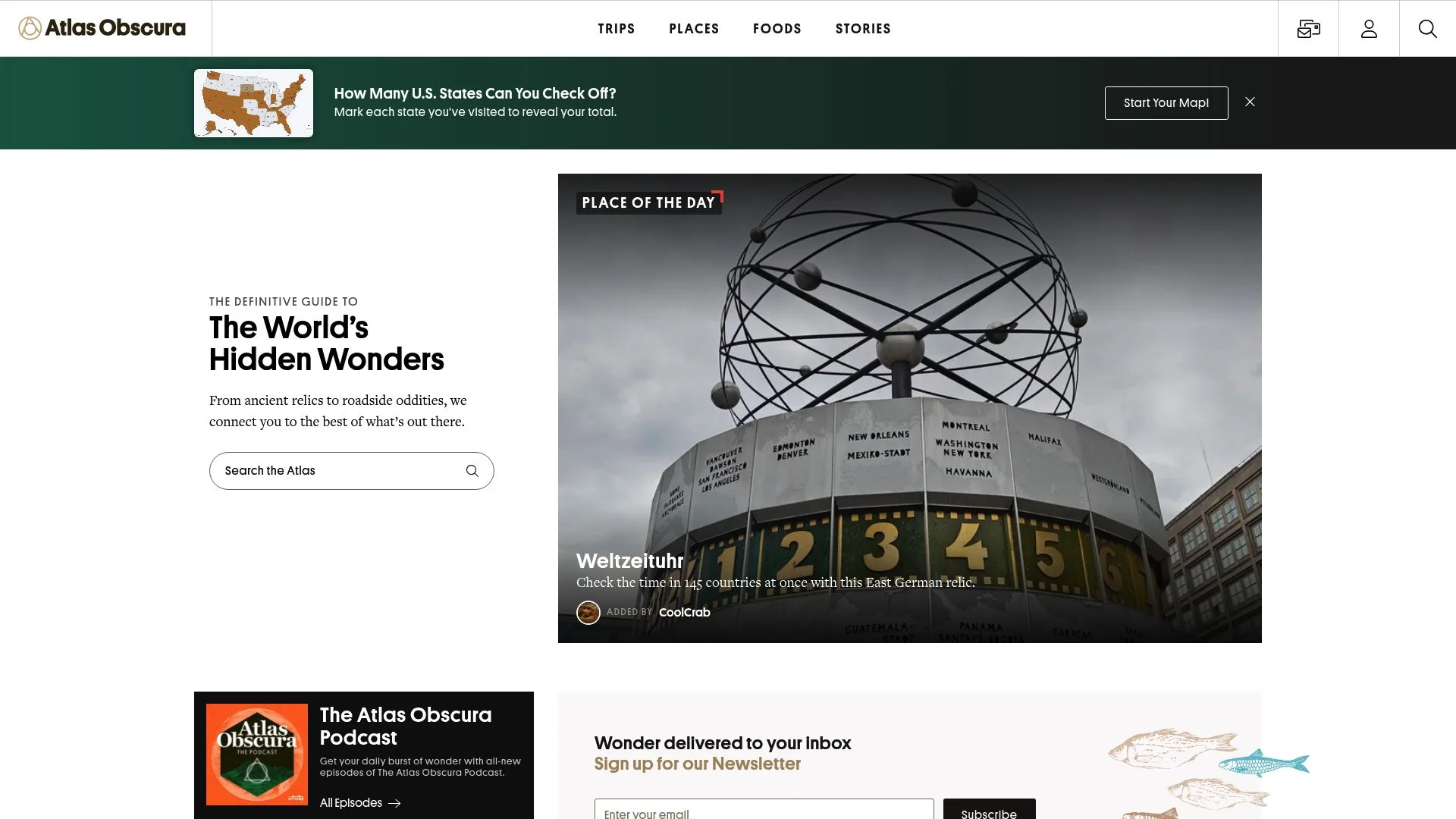
The Ed and Lorraine Warren Occult Museum. The International Church of Cannabis. The Kowloon Walled City.
These aren't random curiosities—they're some of the most-searched destinations on Atlas Obscura, a website that has cataloged over 31,000 of the world's most unusual places, foods, and experiences.
With nearly 900,000 monthly organic visitors and traffic valued at $18.7 million annually, Atlas Obscura has been called "the National Geographic of the digital age." But here's what's remarkable: it wasn't built by travel writers or venture capitalists. It was built by two friends who just loved weird stuff.
Joshua Foer (author of Moonwalking with Einstein) and Dylan Thuras (documentary filmmaker) created Atlas Obscura in 2009 "almost like an art project." They made it for people like themselves—curious explorers who wanted to discover the world's hidden wonders.
The Challenge
It Started With a 17th-Century Polymath
The story of Atlas Obscura starts with Athanasius Kircher. Joshua Foer ran a blog dedicated to the 17th-century German Jesuit polymath—a man who studied everything from Egyptian hieroglyphics to volcanoes to the plague.
When Foer announced a real-world meetup for the "Athanasius Kircher Society" in 2007, Dylan Thuras replied. "We had a packed house, and The New Yorker did a Talk of the Town piece," Dylan recalled. "On top of that, we really enjoyed working together and found kindred spirits."
The meetup planted a seed. In 2008, they hired a web designer. In 2009, they launched the first version of Atlas Obscura—a "collaborative project" to document the world's most curious and wondrous spots.
They didn't intend to build a business. As Joshua told Boston Magazine: "We created it almost like an art project. We made it for people like us."
Within the first year, Atlas Obscura was organically attracting 200,000 unique visitors per month.
Directory Overview
| Website | atlasobscura.com |
| Founded | 2009 |
| Founders | Joshua Foer, Dylan Thuras |
| Focus | Unusual places, foods, and experiences |
| Database Size | 31,000+ places and foods |
| Total Funding | $37.9 million |
| Key Investors | Airbnb ($20M round), The New York Times, NAV.VC |
Key Metrics (Ahrefs, January 2026)
894K
Monthly organic traffic
$18.7M
Annual traffic value
86
Domain Rating
7.5M
Total backlinks
Called "the National Geographic of the digital age"—built by two friends who loved weird places.
Traffic Sources
What The Numbers Tell Us
Inherently Shareable Content: Atlas Obscura content is designed to make you say "I didn't know that existed!" This shareability drives social traffic, backlinks, and word-of-mouth growth.
91,300 Referring Domains: When journalists write about unusual places, they often cite Atlas Obscura. These editorial links from news sites, travel publications, and blogs drive massive authority.
Strong Brand Searches: "Atlas Obscura" drives 35,000 monthly searches—proof that the brand has become synonymous with unusual travel discovery.
Monetization
Diversified Revenue Streams
Trips and Experiences
Small-group adventures to unique destinations worldwide. Not typical tourist trips—expeditions to the hidden wonders in the database. Significant revenue from transforming content into travel business.
Advertising & Sponsorships
High-intent travel enthusiasts are valuable to advertisers. Tourism boards, outdoor brands, and travel companies advertise to reach curious, adventurous travelers.
Books & Podcast
The Atlas Obscura book series has been a bestseller. Daily podcast featuring unusual places and stories creates another content channel and advertising inventory.
Why This Model Works
Content → Experiences: Atlas Obscura didn't stop at cataloging unusual places—they started offering trips to them. This transforms a content business into an experience business with much higher revenue per customer.
Airbnb Partnership: When Airbnb invested $20 million, they also integrated Atlas Obscura content into their platform. This partnership expanded reach to Airbnb's massive travel-planning audience.
The Obscura Day Effect: Since 2010, Atlas Obscura has organized Obscura Day—simultaneous events worldwide exploring unusual places. These events build community, generate press, and create user-generated content.
Build Your Directory Business
Atlas Obscura started as an art project and raised $37M. Learn how passion projects become category-defining platforms.
Subscribe to Directory Gems
SEO & Content Strategy
Top Ranking Keywords
| Keyword | Volume | Position |
|---|---|---|
| atlas obscura | 35,000 | #1 |
| ed and lorraine warren museum | 4,200 | #1 |
| kowloon walled city | 52,000 | #4 |
| best sights in rome | 37,000 | #6 |
| international church of cannabis | 3,100 | #1 |
The Content Flywheel
31,000 Unique Place Pages: Every unusual place has a dedicated page with location, description, photos, and visitor tips. This creates thousands of landing pages for specific searches.
Curiosity-Driven Intent: Atlas Obscura ranks for searches that express curiosity rather than booking intent—"weirdest museums," "hidden gems," "unusual things to see." These searchers become engaged readers.
User-Generated + Editor-Curated: Anyone can submit a place to Atlas Obscura. Editors review and curate submissions, ensuring quality while enabling community contribution at scale.
Competitive Landscape
| Competitor | Focus | Atlas Obscura Advantage |
|---|---|---|
| tripadvisor.com | General travel reviews | Unusual/curious focus vs. mainstream |
| lonelyplanet.com | Travel guides | Hidden gems vs. standard tourist sites |
| roadsideamerica.com | US roadside attractions | Global scope, broader categories |
| wikipedia.org | General information | Curated editorial voice, trip planning |
Key Lessons
🎨 Start as an Art Project
Foer and Thuras didn't set out to build a business. They created something they loved for people like themselves. That authenticity attracted an engaged community before any monetization existed.
📤 Shareability Beats Marketing
Content that makes people say "wow, I didn't know that existed!" drives organic growth through social shares, backlinks, and word-of-mouth. Build content people want to share.
👥 User + Editorial Hybrid
Anyone can submit places, but editors curate what gets published. This hybrid model scales content creation while maintaining quality—best of both worlds.
🎪 Events Build Community
Obscura Day transforms online visitors into real-world community members. Events create memories, loyalty, and content that pure digital plays can't match.
✈️ Content → Experiences
Atlas Obscura didn't stop at cataloging—they started offering trips. This transforms a content business into an experience business with higher revenue per customer.
🔮 Find Your Weird Niche
Atlas Obscura succeeded by focusing on unusual, hidden, curious places—not competing with TripAdvisor on mainstream tourism. Find the angle that makes your directory unique.
Conclusion
Here's what Atlas Obscura taught me: The best directories often start as passion projects for communities of one.
Joshua Foer and Dylan Thuras created Atlas Obscura for "people like us"—curious explorers who wanted to discover hidden wonders. They didn't commission market research or write business plans. They built something they personally wanted to exist.
That authenticity attracted 200,000 monthly visitors in the first year—without marketing, without funding, without a clear business model. The community came because the content was genuinely remarkable.
Sixteen years and $37 million in funding later, Atlas Obscura has been called "the National Geographic of the digital age." But it started as two friends who met at a meetup for a 17th-century polymath.
The core insight: Find your weird passion. Build for people like yourself. Make something so interesting that people can't help but share it. The business model can come later. First, create something remarkable.
Want More Directory Success Stories?
Get weekly case studies on successful directories, growth strategies, and actionable tactics delivered to your inbox.
Subscribe to Directory Gems
Sources: Ahrefs (traffic data, January 2026), Tracxn, Wikipedia, Get Together, Boston Magazine, Crunchbase.
Related Case Studies
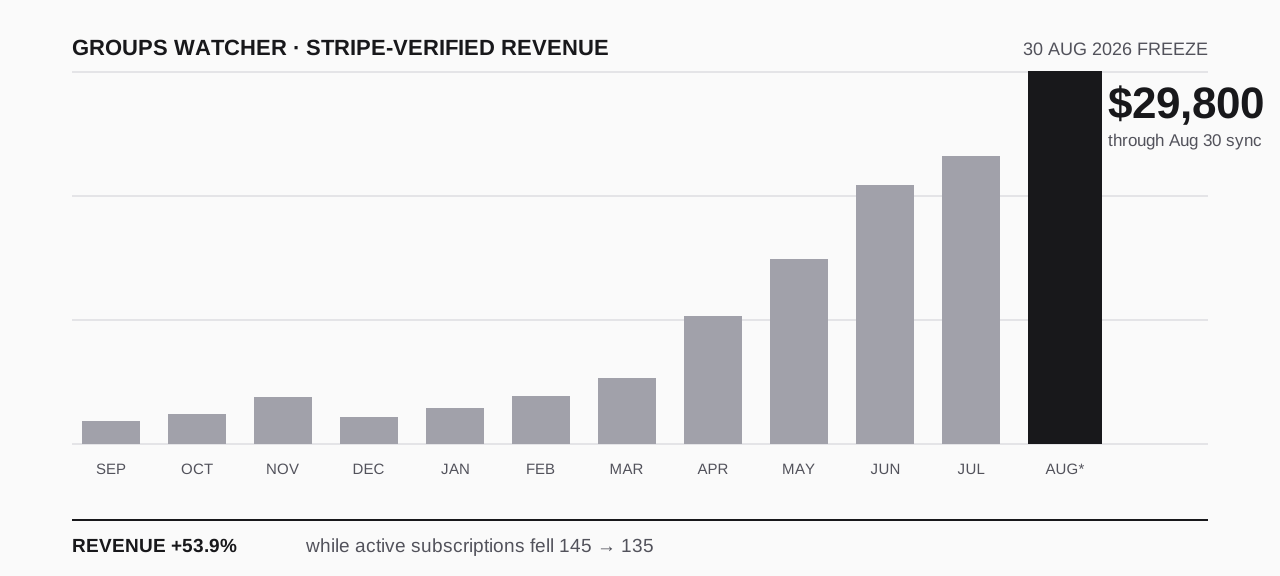
Groups Watcher's August revenue rose 53.9% while active subscriptions fell. Its product history explains the paradox: an alert extension became managed monitoring, then a done-for-you lead service.

A course teaching one arborist exam earns $35,683 a month on a domain Google sends no traffic to. Then the founder cloned it in Spanish — same product, same instructor — and it made $278. Here is what that proves.
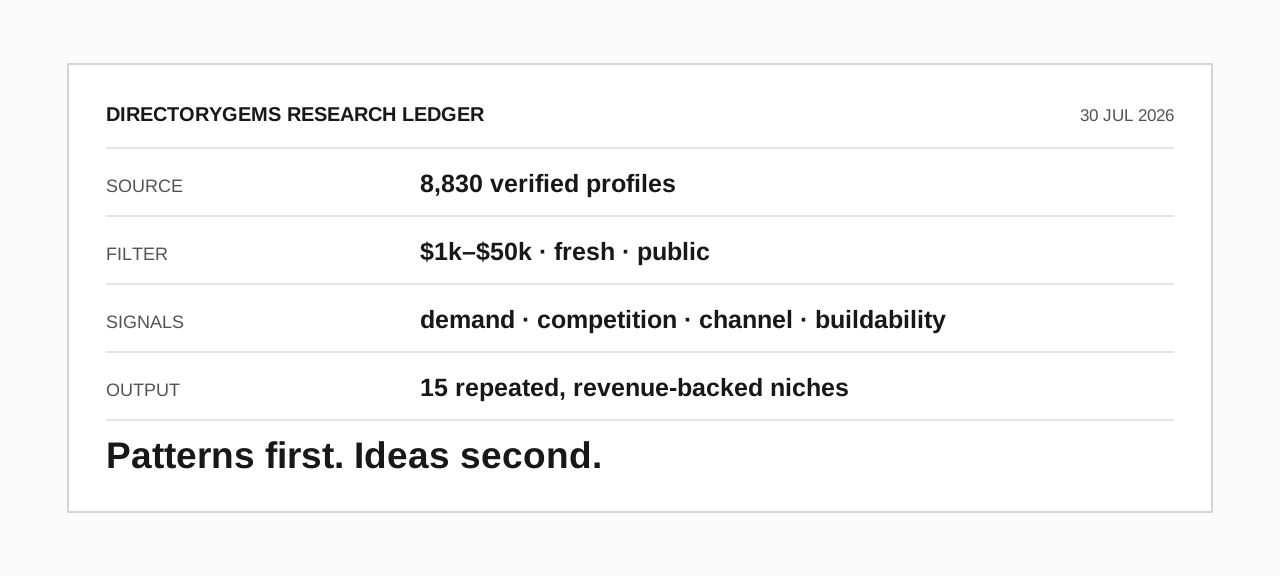
Most micro SaaS idea lists are invented. These 15 are each backed by named companies whose revenue is read from Stripe and RevenueCat APIs — with the exact revenue, domain rating and follower count behind every one.
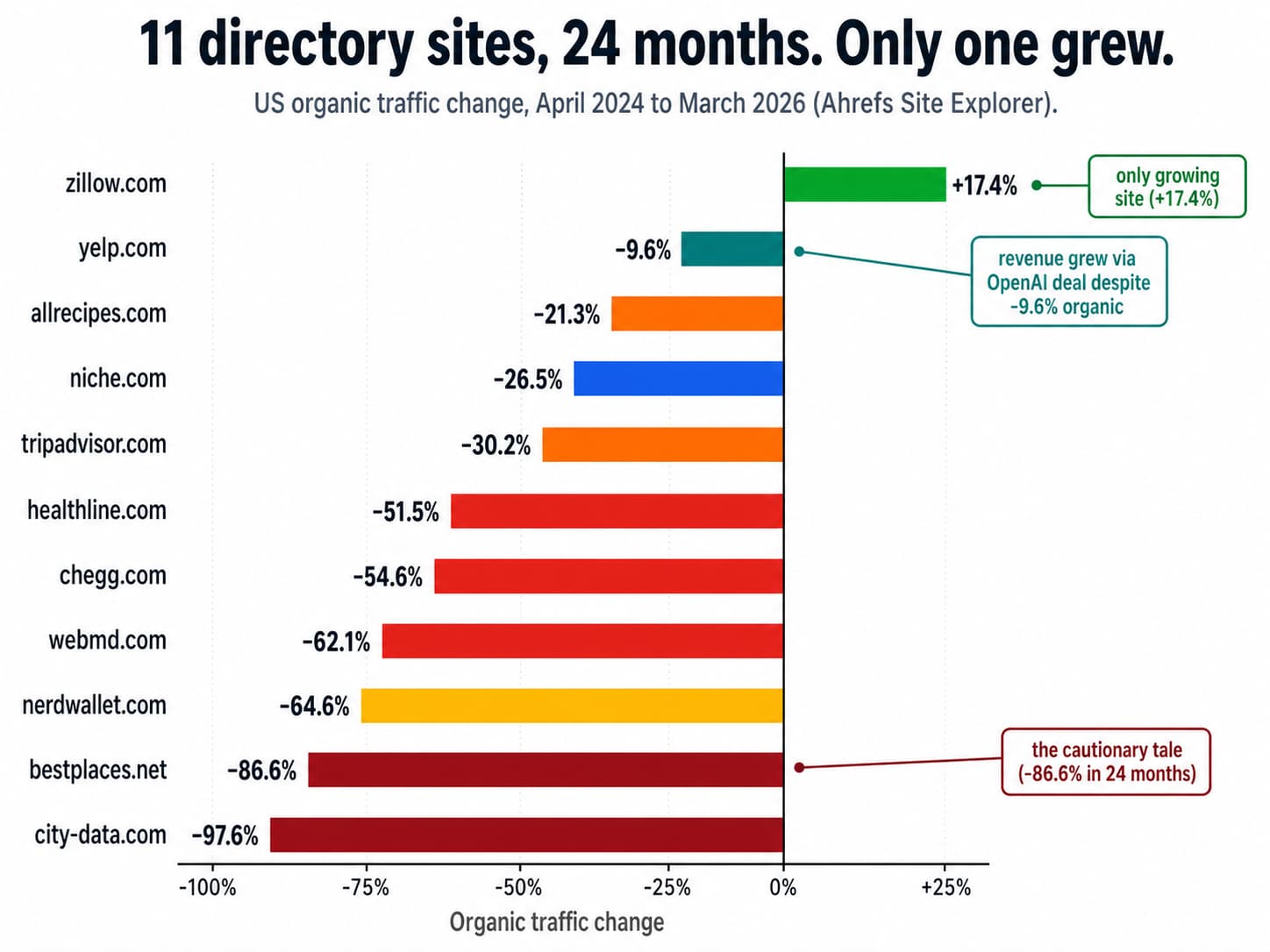
Of 11 directory sites audited against Ahrefs in April 2026, only Zillow grew. Two-thirds lost 21–98%. Six repeatable patterns separate winners, decoupled survivors, and dying directories.