From Forum Thread to $140M in Transactions: How Flippa Created the Marketplace for Websites
154K
Monthly Visitors
$7.8M
Traffic Value/yr
DR 80
Domain Rating
12.4K
Ref. Domains
Matt Mickiewicz started his first business at 14.
That's not a typo. In the late 1990s, while other teenagers were playing video games, Matt was building webmaster-resources.com. It eventually became SitePoint—one of the most influential web development communities of the 2000s.
Here's what happened next: As SitePoint's forums grew, members started asking to buy and sell websites from each other. It was informal at first—just threads in the marketplace section. But the demand kept growing.
In 2009, Matt and his co-founder Mark Harbottle spun that forum marketplace into its own platform: Flippa.
Today, Flippa has facilitated over $140 million in website transactions, with the largest single sale hitting $35 million. It processes 12,000 deals annually and serves 600,000+ buyers and investors worldwide.
From forum threads to the eBay of online businesses.
The Challenge
Forum Users Wanted to Trade Websites
SitePoint was a web development community. Members learned to build websites, shared code, discussed best practices. But many developers also had side projects—websites they'd built but no longer maintained.
Around the late 2000s, SitePoint's forums saw increasing activity in the marketplace section. Developers were buying and selling websites from each other. It was messy—trust issues, payment problems, no standardized process.
Matt and Mark realized they were sitting on something bigger: a market for digital assets.
In 2009, they extracted the marketplace into its own platform: Flippa.com. The idea was simple—eBay for websites. Sellers list their sites with traffic stats, revenue data, and asking prices. Buyers browse, bid, and purchase.
What started as an internal forum feature became a standalone business.
Directory Overview
| Website | flippa.com |
| Founded | 2009 (spun off from SitePoint) |
| Founders | Matt Mickiewicz, Mark Harbottle |
| Origin | SitePoint marketplace forums |
| Focus | Marketplace for websites, apps, and online businesses |
| Transaction Volume | $140M+ (by 2015) |
| Largest Sale | $35 million (Singapore app portfolio) |
Key Metrics (Ahrefs, January 2026)
154K
Monthly organic traffic
$7.8M
Annual traffic value
80
Domain Rating
11.5M
Total backlinks
Part of the SitePoint family: SitePoint, 99designs, Flippa, Learnable—all from the same founders.
Platform Scale
12K+
Annual deals
600K+
Buyers/investors
$35M
Largest single sale
$140M+
Total transactions
What The Numbers Tell Us
Category-Defining Position: Flippa ranks #1 for "websites for sale," "online business for sale," and related terms. They've become synonymous with the category they created.
Strong Brand Searches: "Flippa" itself drives 16,000 monthly searches. Brand awareness creates a moat competitors struggle to overcome.
Network Effects at Work: More sellers attract more buyers. More buyers attract more sellers. The marketplace becomes more liquid and valuable over time.
Monetization
Marketplace Fees
Listing Fees
Sellers pay to list their businesses on the marketplace. Different tiers offer different visibility and features.
Success Fees
When a deal closes, Flippa takes a percentage. This aligns incentives—Flippa makes money when sellers succeed.
Due Diligence & Verification
Flippa verifies traffic and revenue data, reducing fraud risk. Premium verification services add revenue while building trust for high-value transactions.
Why This Model Works
Built-In Audience from SitePoint: Flippa didn't start from zero. It launched to SitePoint's massive web developer community—people who already wanted to buy and sell websites.
Trust Through Verification: High-value transactions (Flippa's largest was $35M) require trust. Verification, escrow, and due diligence features made these possible.
Expanding Asset Types: What started with websites expanded to domains, apps, SaaS businesses, and ecommerce stores. Each category attracted new buyers and sellers.
Build Your Directory Business
Flippa shows how forum activity can reveal business opportunities. Learn to spot and extract value from communities with our weekly case studies.
Subscribe to Directory Gems
SEO & Content Strategy
Top Ranking Keywords
| Keyword | Volume | Position |
|---|---|---|
| flippa | 16,000 | #1 |
| websites for sale | 1,600 | #1 |
| online business for sale | 3,100 | #1 |
| website for sale | 800 | #1 |
| youtube channels for sale | 800 | #1 |
The Content Flywheel
Every Listing is a Page: Each listing is a unique page that can rank for specific searches related to that business type. Active marketplace = continuous fresh content.
Own the Category Keywords: By launching early in the "website trading" space, Flippa became synonymous with it. "Let's list it on Flippa" is how people talk about selling websites.
First-Mover Advantage: When Flippa launched in 2009, there wasn't a dedicated marketplace for online businesses. They defined the category.
The SitePoint Family
Multiple Businesses from One Community
Flippa isn't the only successful company to emerge from SitePoint. Matt Mickiewicz and Mark Harbottle's web development community spawned multiple businesses:
SitePoint (1999) - Original web development community
99designs (2008) - Crowdsourced design marketplace
Flippa (2009) - Marketplace for online businesses
Learnable - Online learning platform
Key Lessons
👀 Communities Reveal Opportunities
Flippa emerged from observing what SitePoint users were already trying to do. The marketplace existed informally—Matt just formalized it.
🧒 Start at Any Age
Matt started his first business at 14. Age isn't a barrier—curiosity and willingness to build are what matter.
🔧 Extract Features into Products
SitePoint's marketplace forum became Flippa. 99designs emerged from design contest threads. Successful features can become standalone businesses.
🔒 Trust Enables Transactions
High-value transactions ($35M largest) require trust. Verification, escrow, and due diligence features made these possible.
🏆 First-Mover Defines Category
By launching early in "website trading," Flippa became synonymous with it. "List it on Flippa" is how people talk about selling websites.
📈 Expand Asset Types
Started with websites, expanded to domains, apps, SaaS, ecommerce. Each category attracted new buyers and sellers to the platform.
Conclusion
Here's what Flippa taught me: The best business ideas often emerge from what your community is already trying to do.
Matt Mickiewicz didn't decide to create a website marketplace in a vacuum. He watched SitePoint members trying to trade websites in forum threads. The demand was obvious—they just needed a better platform.
Flippa extracted that forum activity into a dedicated marketplace. Fifteen years later, it's facilitated over $140 million in transactions.
The core insight: Look at what communities are already doing informally. What trades are happening in forum threads? What requests keep appearing? Those informal activities might be your next business.
What's happening in your community that deserves its own platform?
Want More Directory Success Stories?
Get weekly case studies on successful directories, growth strategies, and actionable tactics delivered to your inbox.
Subscribe to Directory Gems
Sources: Ahrefs (traffic data, January 2026), Wikipedia, Mixergy, Yaro.blog, BusinessIdeasLab.
Related Case Studies
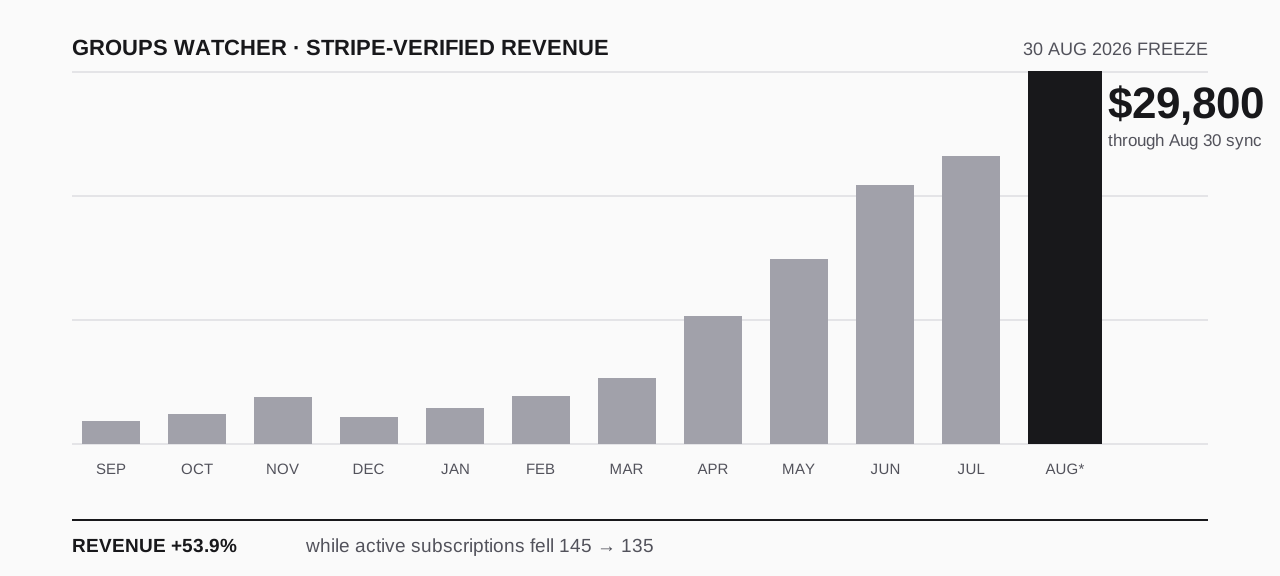
Groups Watcher's August revenue rose 53.9% while active subscriptions fell. Its product history explains the paradox: an alert extension became managed monitoring, then a done-for-you lead service.

A course teaching one arborist exam earns $35,683 a month on a domain Google sends no traffic to. Then the founder cloned it in Spanish — same product, same instructor — and it made $278. Here is what that proves.
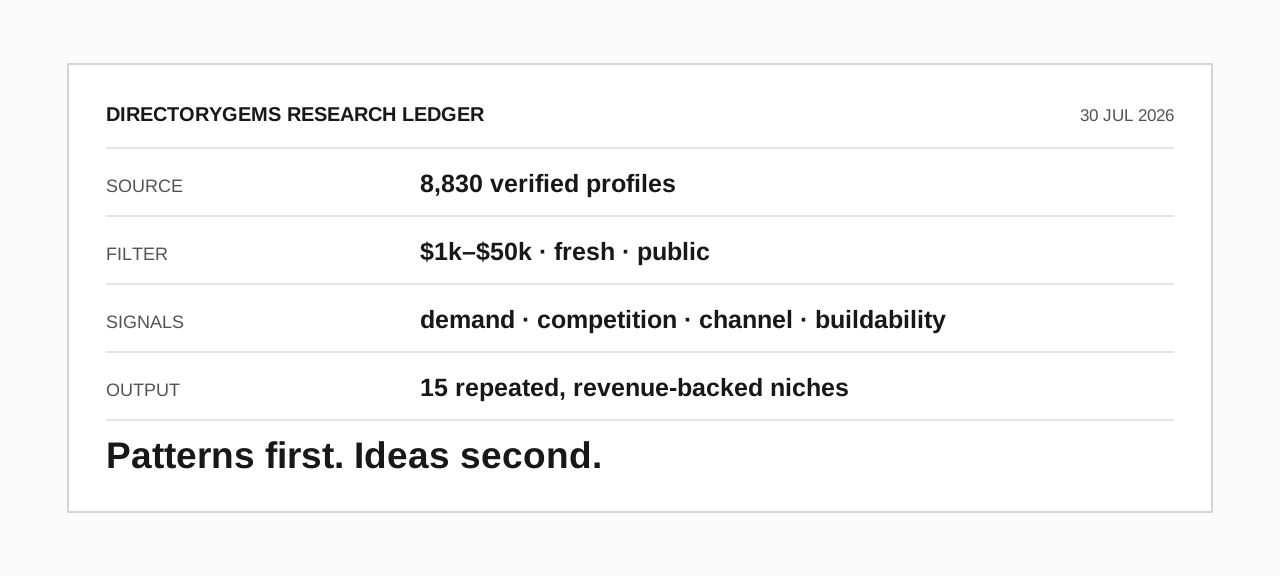
Most micro SaaS idea lists are invented. These 15 are each backed by named companies whose revenue is read from Stripe and RevenueCat APIs — with the exact revenue, domain rating and follower count behind every one.
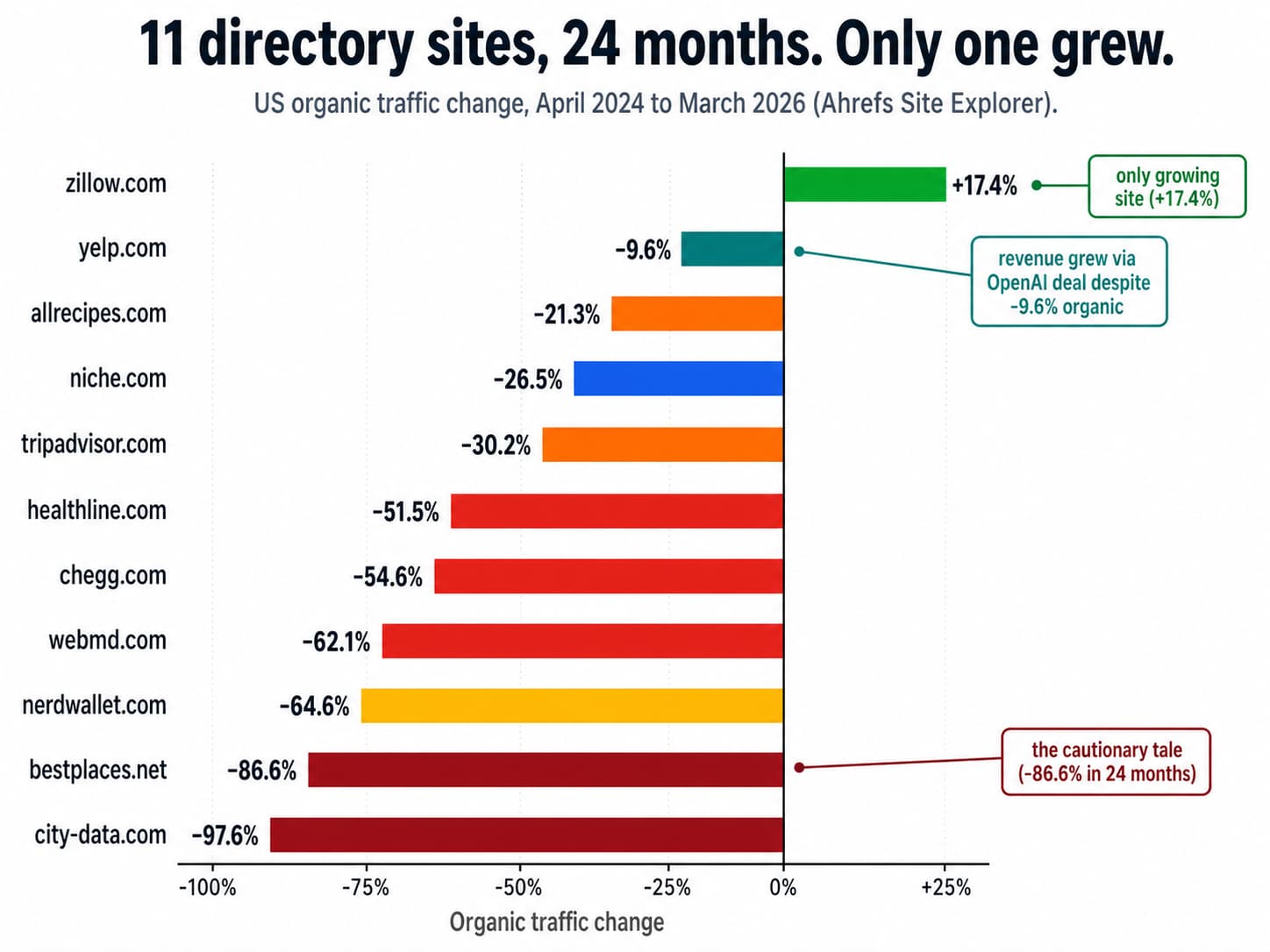
Of 11 directory sites audited against Ahrefs in April 2026, only Zillow grew. Two-thirds lost 21–98%. Six repeatable patterns separate winners, decoupled survivors, and dying directories.