- What is Growjo?
- How accurate are Growjo's revenue estimates?
- Where does Growjo get its data?
- How does Growjo make money?
- Growjo alternatives
- The Full Teardown: How Growjo Built a $3M, 2-Person Directory
- 1. Directory Overview
- 2. Traffic and Growth Analysis
- 3. Monetization Strategy
- 4. SEO and Content Strategy
- 5. Data Enrichment and User Experience
- 6. Competitive Landscape
- 7. Lessons
- Conclusion
- What is Growjo?
- How accurate are Growjo's revenue estimates?
- Where does Growjo get its data?
- How does Growjo make money?
- Growjo alternatives
- The Full Teardown: How Growjo Built a $3M, 2-Person Directory
- 1. Directory Overview
- 2. Traffic and Growth Analysis
- 3. Monetization Strategy
- 4. SEO and Content Strategy
- 5. Data Enrichment and User Experience
- 6. Competitive Landscape
- 7. Lessons
- Conclusion
Growjo: What It Is, How Accurate Its Revenue Estimates Are & Alternatives
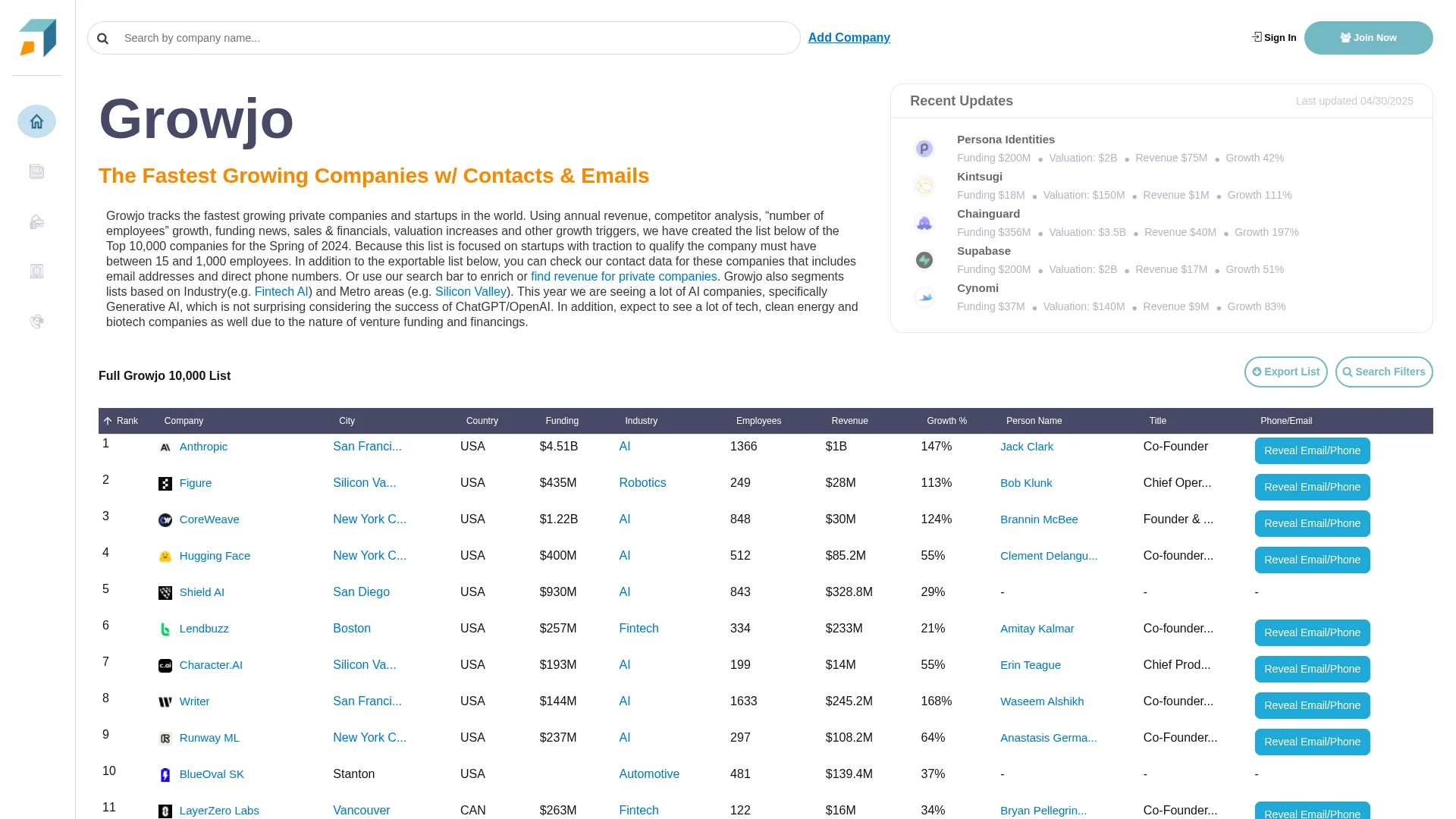
If you searched for a specific company's revenue and landed on Growjo, here's the first thing to know: Growjo's revenue and employee figures are algorithmic estimates, not audited financials — useful for ballpark sizing and spotting fast-growing companies, but not exact. Below: what Growjo is, how it builds those estimates, how accurate they are, how it makes money, and the best alternatives.
Founded by Tom Blue in 2019, Growjo is a directory of fast-growing companies that pairs a proprietary growth-prediction algorithm with contact and revenue data, focused on businesses with roughly 15–1,000 employees — the stage where a company has proven its model but isn't yet a household name. It's also a remarkable directory business: a ~$3M operation run by a tiny team, which is why we tear it down in full further down this page.
What is Growjo?
Growjo (growjo.com) is a business directory that ranks and profiles fast-growing companies, publishing estimated revenue, employee counts, growth rates, and decision-maker contact data. Its algorithm watches growth signals — hiring sprees, funding rounds, traffic and revenue jumps — to surface companies before they hit the mainstream. Investors use it to spot risers early, sales teams to find companies with budget, and job seekers to find rocket ships.
How accurate are Growjo's revenue estimates?
Treat them as directional estimates, not exact figures. Growjo's revenue numbers are modeled from its algorithm plus data inherited from founder Tom Blue's Lead411 platform and public signals — not company-reported, audited financials. In practice that means:
- They're most reliable as an order-of-magnitude or range ("a low-eight-figure company") and for relative comparisons (who's growing faster).
- They can be off for private companies, can lag recent changes, and vary in quality with how much public data exists on a company.
- For anything that needs precision (due diligence, a deal), cross-check Growjo against the company's own disclosures and at least one other source (see alternatives below).
This isn't unique to Growjo — every company-revenue-estimate tool (Owler, RocketReach, ZoomInfo and the rest) models numbers the same way. The right mental model: use Growjo to size and rank, not to quote a company's exact revenue.
Where does Growjo get its data?
Three layered sources: (1) the Lead411 data heritage (contacts + firmographics), (2) a proprietary algorithm that infers growth from hiring, funding and traffic signals, and (3) self-reported / badge data from companies that display "Fastest Growing Company" badges (which also feed Growjo's backlinks).
How does Growjo make money?
Mostly enterprise API licensing (~$10,000/year to license the company data + growth algorithm), plus freemium access (basic lists free; contacts, filters and API paid), contact-data sales to sales teams, lead generation from free downloads, and light advertising. It's a high-value, low-volume model — a big reason a ~2-person team reaches ~$3M in revenue. (Full monetization breakdown in the teardown below.)
Growjo alternatives
If Growjo's estimate doesn't fit your use case, the closest alternatives are:
- CB Insights — broader market intelligence; deeper and pricier, less growth-prediction focus.
- Owler — community-driven competitive insights and revenue estimates.
- RocketReach — massive contact database; great for emails, no growth layer.
- LeadIQ — sales prospecting and contact data; no growth-prediction algorithm.
- Tracxn — startup and funding tracking with broad coverage.
Building a directory yourself? Browse our profitable directory case studies and gauge any niche with the Opportunity Finder.
The Full Teardown: How Growjo Built a $3M, 2-Person Directory
Beyond evaluating Growjo as a data source, it's a remarkable directory business. For directory builders, here is the full teardown — traffic, monetization, SEO, and the lessons behind a ~$3M operation run by two people. The sections below expand on the summaries above.
1. Directory Overview
| Company Profile | Details |
|---|---|
| Name | Growjo |
| URL | https://growjo.com |
| Niche | The Fastest Growing Companies with Contacts |
| Year Founded | 2019 |
| Current Monthly Visitors | 620.4K |
Estimated Annual Revenue
Official Revenue Data:
- Current Annual Revenue: $3,000,000 (as reported on growjo.com)
- Revenue per Employee: $1,500,000 (2 employees)
- Annual Pricing: $10,000 per enterprise client
- Estimated Enterprise Clients: ~300 active subscribers
Business Model: High-value enterprise API licensing
Operational Efficiency: $1.5M revenue per employee
Market Position: Premium data provider in growth intelligence
Note: Revenue data sourced directly from Growjo's company profile at growjo.com/company/growjo. This represents a significant scale-up from earlier estimates, demonstrating the company's rapid growth trajectory.
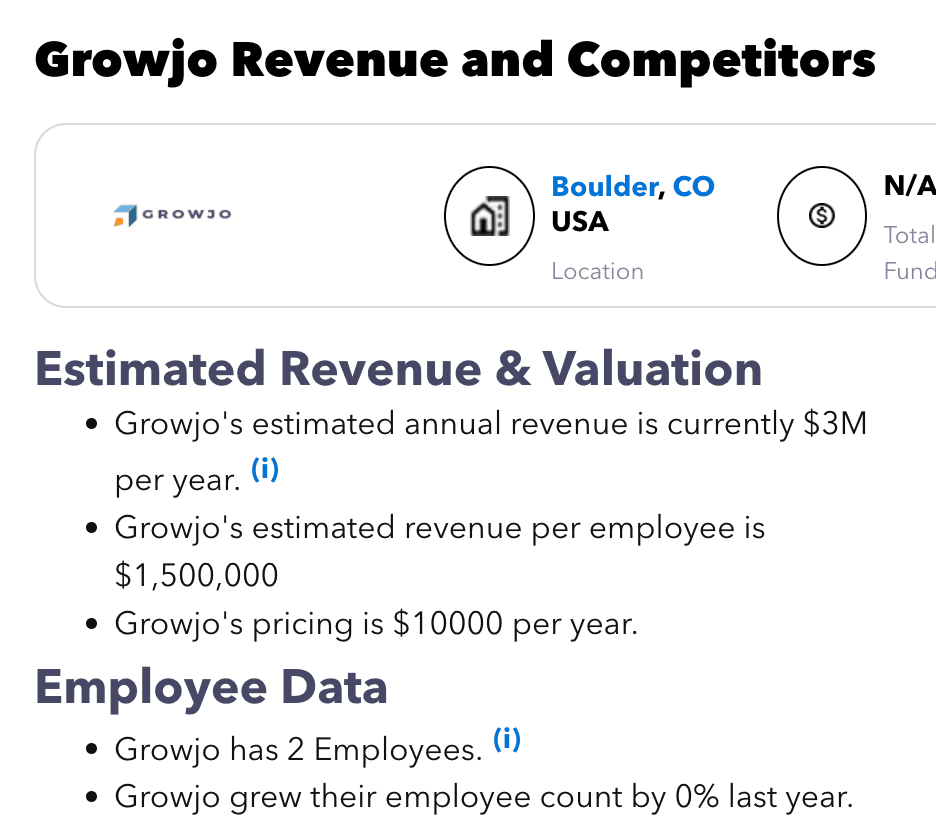
Growjo's official company profile showing $3M annual revenue, $1.5M revenue per employee, and competitive positioning in the business intelligence space
2. Traffic and Growth Analysis
Monthly Traffic Overview
Total Monthly Traffic
620.4K
Organic Traffic
35.9K
Visitor Engagement
Avg. Time on Site
00:01:43
Pages per Visit
2.61
Bounce Rate
52.4%
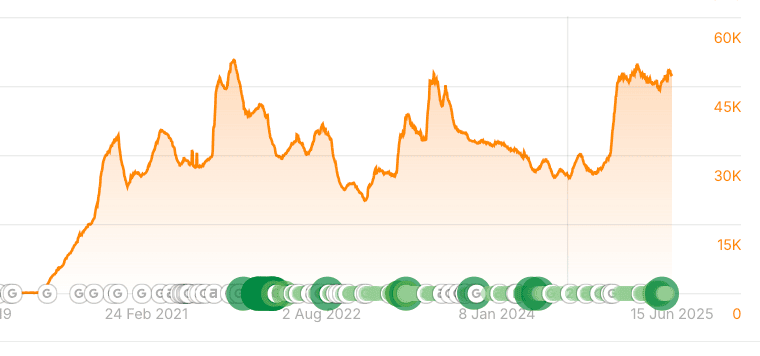
Growjo's organic traffic growth showing steady upward trajectory with seasonal fluctuations, reaching peaks of 60K+ monthly visits
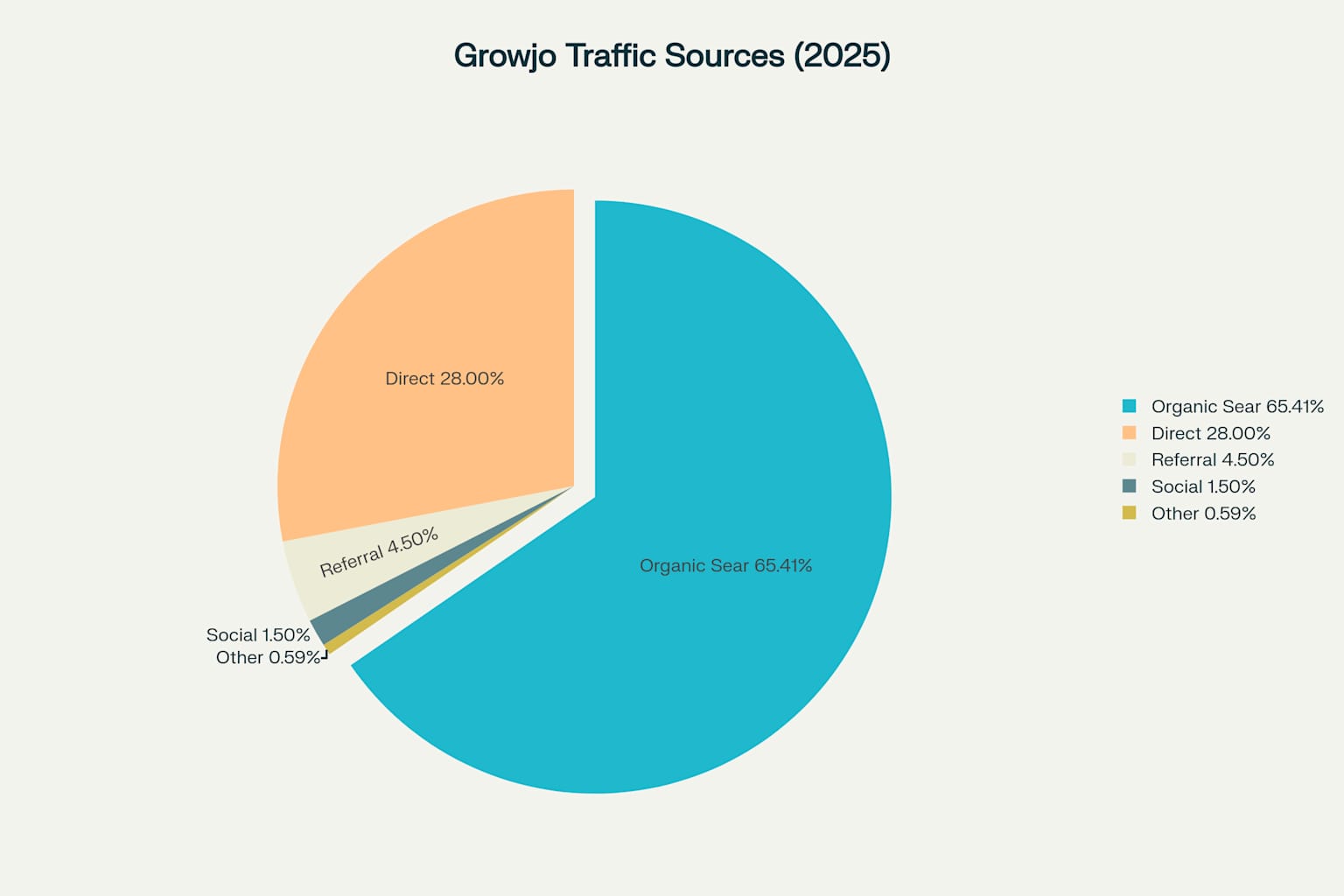
Visual breakdown of Growjo's traffic sources showing organic search dominance at 65.41%, followed by direct traffic at 28%
International Traffic Distribution
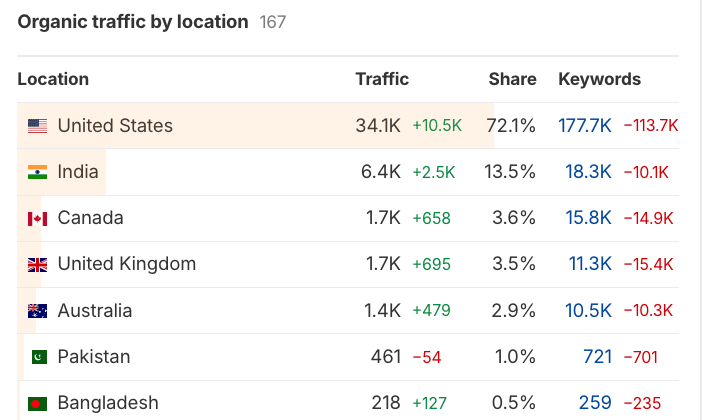
Geographic distribution of Growjo's traffic showing strong US dominance (72.1%) with significant opportunity in India (13.5%) and other English-speaking markets
Growth Drivers
Growjo didn't stumble into success—they engineered it with some seriously clever growth tactics:
1. The Data Advantage Play Instead of starting from scratch, Tom Blue leveraged his existing Lead411 platform to give Growjo instant credibility and a massive head start on data collection. Smart move: why reinvent the wheel when you can upgrade it?
2. The Badge Strategy Here's where Growjo got genius: they created embeddable "Fastest Growing Company" badges that recognized companies could proudly display on their websites. Suddenly, every company they featured became a marketing partner, generating backlinks and social proof automatically.
3. The Recognition Engine Growjo turned company rankings into a self-perpetuating PR machine. They provided ready-made press release templates and social media posts, making it effortless for featured companies to announce their recognition. Result? Free marketing from every company they listed.
4. Geographic and Industry Segmentation By creating dedicated pages for cities ("Fastest Growing Companies in San Diego") and industries ("Fastest Growing Fintech Companies"), Growjo captured highly targeted search traffic that competitors missed.
5. The Algorithm Angle While competitors relied on self-reported data, Growjo emphasized their proprietary algorithm that actually predicts growth. This differentiation attracted media attention and established them as the "smart" alternative to traditional rankings.
Content Freshness Strategy Regular updates to their lists created recurring news cycles and fresh content signals for search engines, keeping them relevant and ranking high.
📧 Want More Case Studies Like This?
Get weekly insights on profitable directories, growth strategies, and monetization tactics delivered to your inbox.
Subscribe to Directory Gems
3. Monetization Strategy
Primary Revenue Streams
Growjo's monetization strategy is a masterclass in balancing free value with premium offerings:
Enterprise API Licensing ($10,000/year) Their bread and butter: licensing their proprietary company data and growth algorithm to businesses. With just 11 enterprise clients needed to hit their current revenue, this high-value, low-volume approach is pure genius.
Freemium Data Access Basic company lists are free to download (hello, traffic magnet), but detailed contact information, advanced filtering, and API access require payment. Classic freemium done right.
Contact Data Monetization They sell access to email addresses and direct phone numbers for decision-makers at fast-growing companies—exactly what sales teams are willing to pay premium prices for.
Lead Generation Every free download captures valuable user data, creating a secondary revenue stream through qualified lead generation.
Strategic Advertising Selective advertising partnerships (including OpenX and Taboola integrations) provide additional revenue without overwhelming the user experience.
4. SEO and Content Strategy
SEO Authority Metrics
Domain Authority
63
Backlinks
26.0K
Referring Domains
4.0K
Keyword Visibility
Total Ranking Keywords
198.0K
Page-Level Traffic Analysis
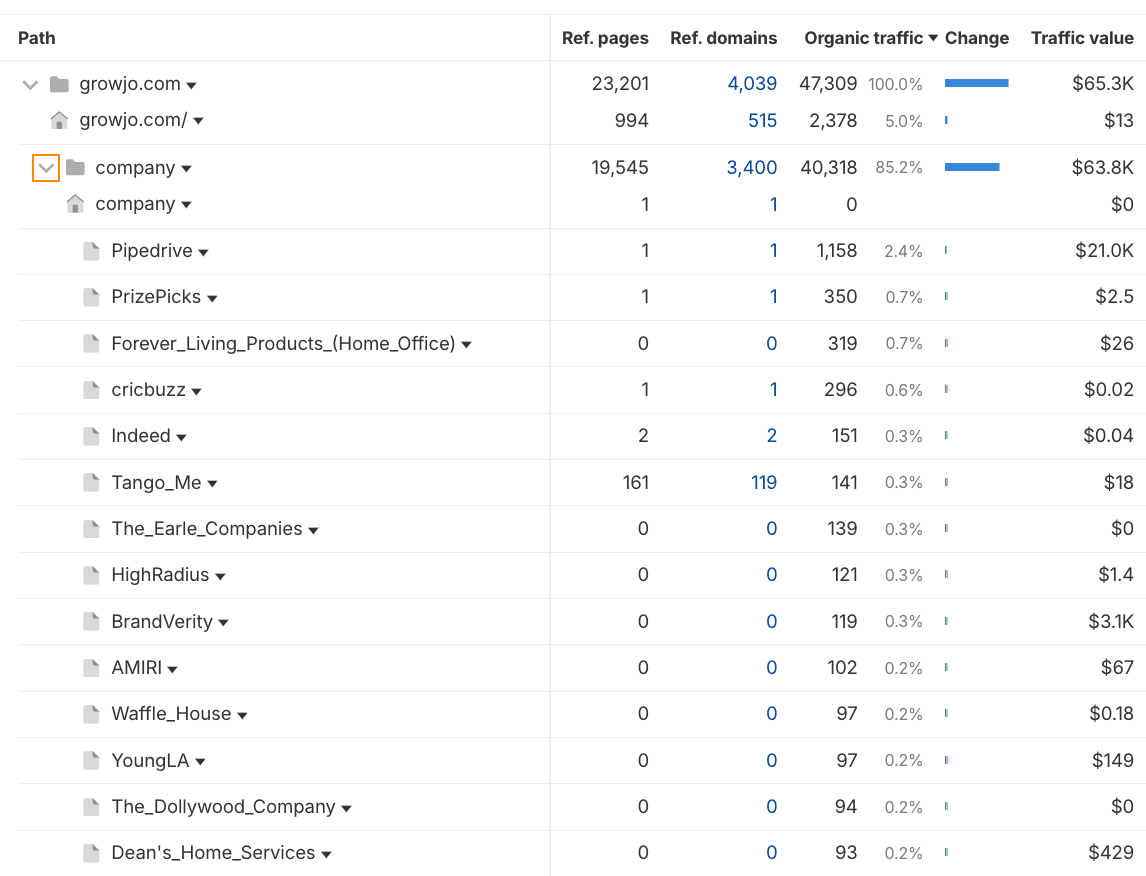
Breakdown of Growjo's most valuable pages showing the /company section driving 85.2% of organic traffic with 40,318 monthly visits
Top Ranking Keywords
Keywords driving organic traffic
| Keyword | Monthly Volume | Traffic | Position |
|---|---|---|---|
| growjo | 900 | 903 | 1 |
| pipedrive revenue | 1900 | 223 | 3 |
| 1440 daily digest | 12000 | 189 | 12 |
| prizepicks net worth | 300 | 109 | 1 |
| grojo | 100 | 99 | 1 |
Backlink Profile Analysis
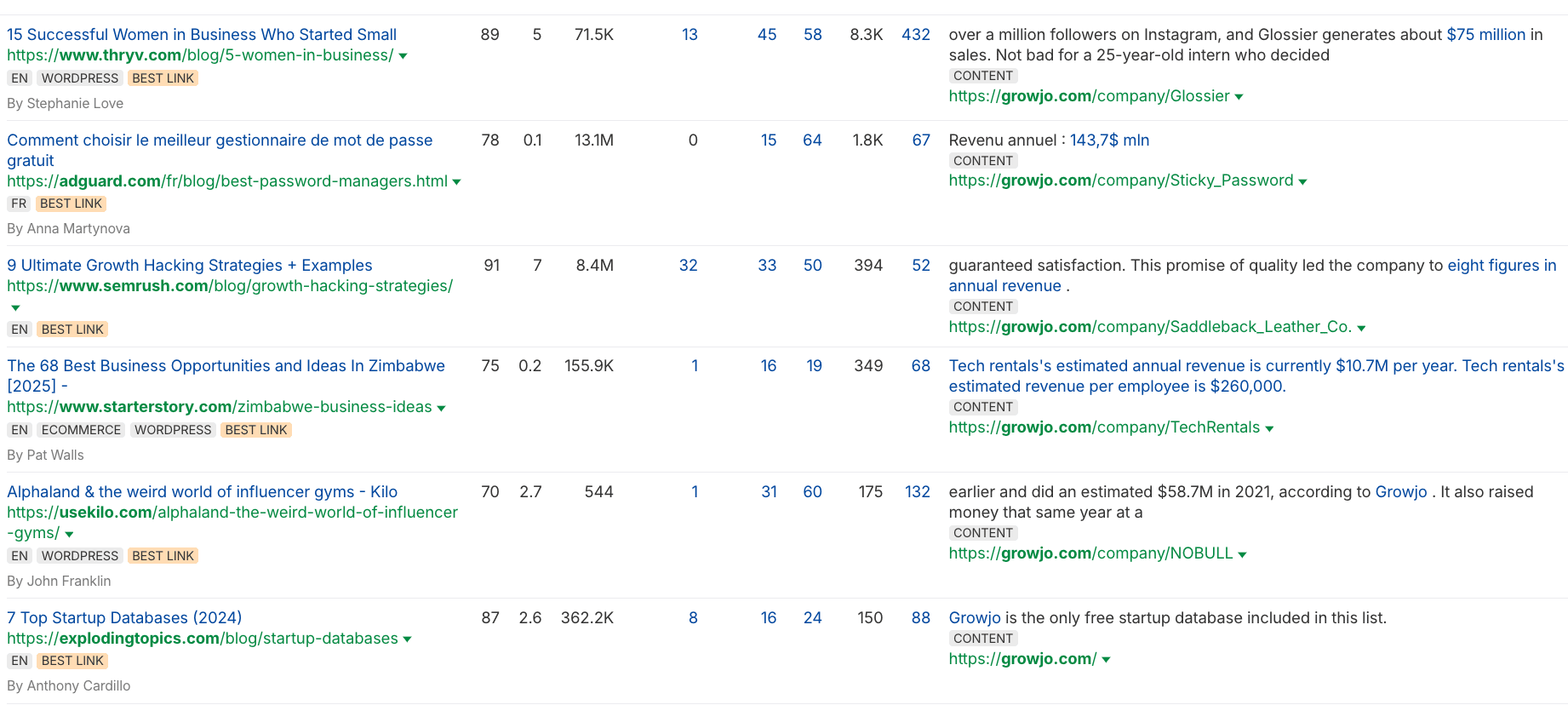
Examples of high-quality backlinks and media mentions Growjo receives, including references from major publications and business blogs discussing company growth and revenue data
Top Organic Competitors
Sites competing for similar keywords
| Competitor | Keywords | Overlap | Traffic |
|---|---|---|---|
| cbinsights.com | 342609 | 8.4% | 45884 |
| leadiq.com | 311033 | 8.3% | 42632 |
| owler.com | 33185 | 8.3% | 19405 |
| tracxn.com | 234010 | 8.2% | 35577 |
| rocketreach.co | 996629 | 7.2% | 86976 |
On-Page SEO Strategy
With a Domain Authority of 63 and nearly 200K ranking keywords, Growjo's SEO game is seriously impressive. Here's how they dominate search:
Geographic SEO Mastery They created dedicated landing pages for every major city, capturing searches like "fastest growing companies in [city]"—a strategy that generates thousands of targeted entry points.
Industry-Specific Content Similar to their geographic approach, industry-specific pages target high-intent searches from investors and sales professionals looking for companies in specific sectors.
The Badge Backlink Strategy Every company displaying a Growjo badge creates a natural backlink, building domain authority while companies proudly show off their recognition.
Content Freshness Signals Regular list updates with "Last updated" timestamps send positive signals to search engines about content relevance and accuracy.
Long-Tail Keyword Capture By ranking for specific company revenue searches (like "Pipedrive revenue"), they capture highly targeted traffic from people researching specific businesses.
User Engagement Optimization Despite a 52.4% bounce rate, their 12+ minute average session duration shows that engaged users really dig deep into the data—a positive ranking signal.
5. Data Enrichment and User Experience
Unique Data/Features
Proprietary Growth Algorithm Unlike competitors who rely on self-reported data, Growjo's algorithm synthesizes multiple growth indicators: hiring trends, funding news, revenue increases, and valuation jumps.
Real-Time Growth Tracking They actively monitor companies for growth signals rather than waiting for annual reports or submissions.
Contact Intelligence Direct email addresses and phone numbers for key decision-makers at fast-growing companies—gold for sales teams.
Predictive Analytics Focus on companies poised for future growth rather than just celebrating past success.
Exportable Data Free, downloadable company lists that provide immediate value to users.
Recognition System Embeddable badges and PR templates that turn listed companies into marketing partners.
UI/UX
Growjo keeps it clean and functional—no fancy bells and whistles, just fast access to the data people need. The interface prioritizes quick scanning and easy exports, perfect for busy investors and sales professionals.
Mobile Experience With significant mobile traffic, the site maintains functionality across devices without sacrificing data density.
Search and Filter Efficiency Users can quickly narrow down companies by industry, location, size, and growth metrics.
User Engagement Challenges: The 52.4% bounce rate and 1:43 average session time suggest room for improvement in user engagement. However, the 2.61 pages per visit indicates that engaged users do explore multiple sections. The challenge seems to be converting casual browsers into deeper explorers—possibly through better onboarding or more compelling initial value propositions.
6. Competitive Landscape
Key Competitors
| Competitor | Key Differentiator |
|---|---|
| CB Insights | Comprehensive market intelligence platform with broader scope but less focus on growth prediction |
| LeadIQ | Sales prospecting tool with contact data but lacks growth prediction algorithm |
| Owler | Company intelligence platform focused on competitive insights rather than growth prediction |
| Tracxn | Startup tracking platform with broader coverage but less specialized growth focus |
| RocketReach | Contact database with massive scale but no growth intelligence layer |
7. Lessons
Proprietary Algorithm Their growth prediction algorithm creates a significant moat—competitors can copy the concept but not the specific methodology and data sources.
Network Effects The badge system creates self-reinforcing growth: more recognized companies = more backlinks = higher search rankings = more companies wanting recognition.
Data Quality Advantage Connection to Lead411's established data infrastructure provides higher quality, more accurate information than competitors relying on self-reported data.
Brand Recognition "Fastest Growing Company" badges have become status symbols that companies actively seek, creating brand loyalty and switching costs.
Lean Operations With just 2 employees generating $108K annually, they can maintain profitability even during market downturns when larger competitors struggle.
Conclusion
Growjo proves that smart beats big in the directory game. With just 2 employees and $3M in annual revenue, they've built a powerhouse by solving one specific problem exceptionally well: predicting which companies will grow fast.
Their winning formula? Leverage existing data sources, create recognition systems that companies promote themselves, and maintain laser focus on your core value. The badge strategy alone turned every listed company into a marketing partner—genius.
For directory builders, the lesson is clear: find an underserved niche, build genuine predictive value, and create systems that scale without adding complexity. Growjo didn't just build a directory—they built a growth intelligence platform that investors and sales teams can't live without.
🚀 Ready to Build Your Own Directory?
Join 80+ entrepreneurs getting actionable insights on directory businesses, case studies, and proven growth tactics.
Get Free Directory Insights
Explore Related Categories
Frequently asked questions
What is Growjo?
Growjo is a directory of fast-growing companies that publishes estimated revenue, employee counts, growth rates and decision-maker contacts, surfaced by a proprietary growth-prediction algorithm. It focuses on companies with about 15 to 1,000 employees.
How accurate are Growjo's revenue estimates?
They are algorithmic estimates, not audited financials. Use them for order-of-magnitude sizing and relative comparisons rather than exact figures, and cross-check against the company's own disclosures and another source for anything precise.
Where does Growjo get its revenue data?
From a mix of the Lead411 data heritage, a proprietary algorithm that infers growth from hiring, funding and traffic signals, and self-reported or badge data from listed companies. The figures are modeled, not company-reported.
How does Growjo make money?
Primarily enterprise API licensing at around $10,000 per year, plus freemium access, contact-data sales, lead generation from free downloads, and some advertising.
Is Growjo legit?
Yes — it is a real, established data product (founded 2019) used by investors, sales teams and job seekers. Just remember its revenue and growth figures are estimates rather than guaranteed-accurate financials.
What are the best Growjo alternatives?
CB Insights for deeper market intelligence, Owler for community revenue estimates, RocketReach for contact data, LeadIQ for sales prospecting, and Tracxn for startup and funding tracking.
Related Case Studies
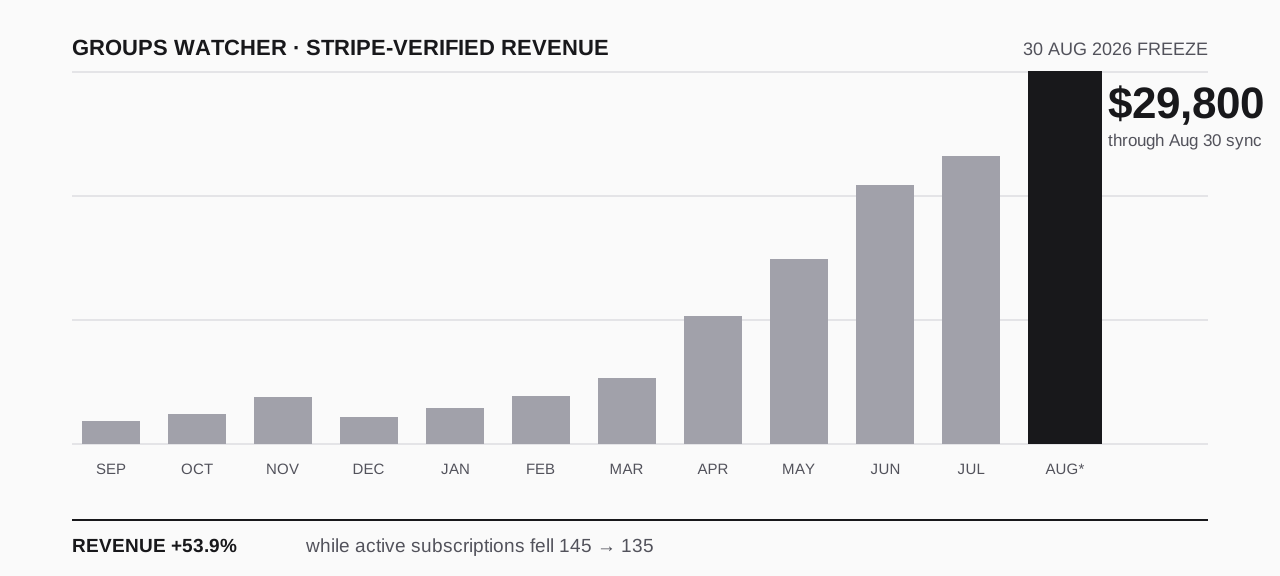
Groups Watcher's August revenue rose 53.9% while active subscriptions fell. Its product history explains the paradox: an alert extension became managed monitoring, then a done-for-you lead service.

A course teaching one arborist exam earns $35,683 a month on a domain Google sends no traffic to. Then the founder cloned it in Spanish — same product, same instructor — and it made $278. Here is what that proves.
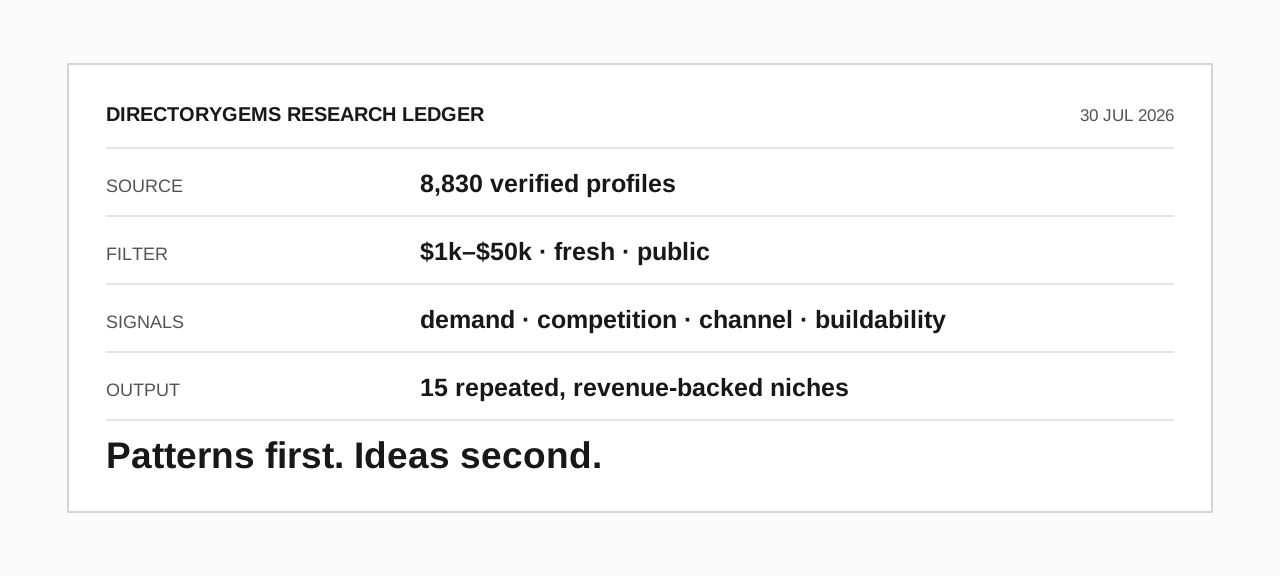
Most micro SaaS idea lists are invented. These 15 are each backed by named companies whose revenue is read from Stripe and RevenueCat APIs — with the exact revenue, domain rating and follower count behind every one.
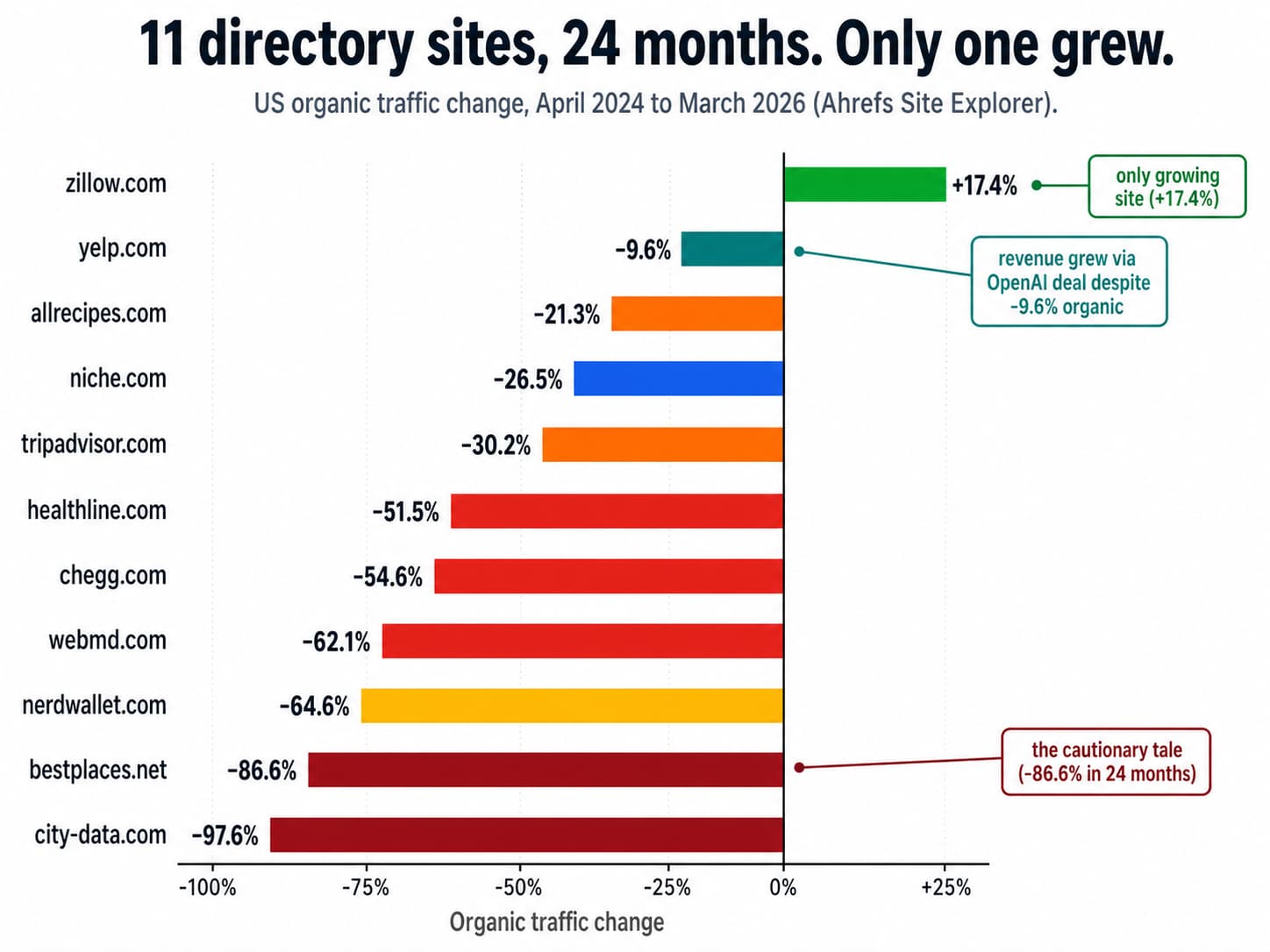
Of 11 directory sites audited against Ahrefs in April 2026, only Zillow grew. Two-thirds lost 21–98%. Six repeatable patterns separate winners, decoupled survivors, and dying directories.