Conductor: $43,555 MRR From an API for QuickBooks Desktop
Data snapshot: TrustMRR, synced 2026-10-20 20:25 UTC. October 2026 was incomplete at that sync and is not used as a monthly total. The July comparison is our July 30 pull (Conductor's sync: 2026-07-31 02:34 UTC).
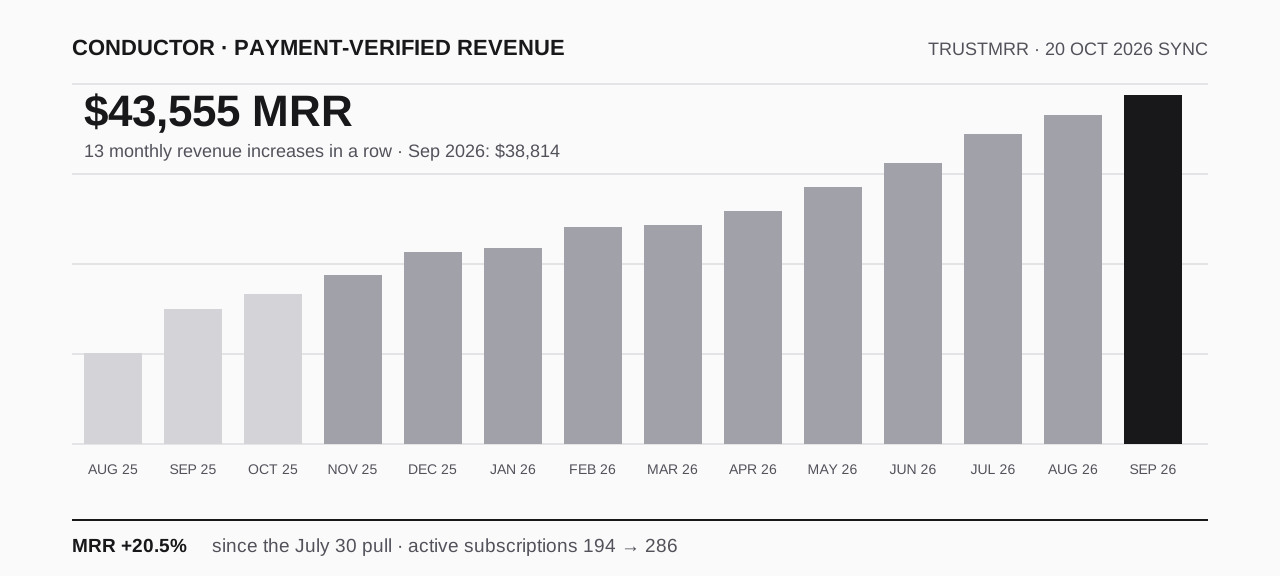
Conductor sells one thing: an API for QuickBooks Desktop. Every calendar month from September 2025 to September 2026 brought in more than the month before.
That is 13 increases in a row, from $14,963 in September 2025 to $38,814 in September 2026, about 2.6 times as much. Conductor's MRR was $43,555 at the October 20 sync, up from $36,148 in our July 30 pull.
The product is not new technology. It is an adapter. QuickBooks Desktop is software that runs on Windows machines, and Intuit stopped selling Desktop editions to new US customers in 2024, Enterprise excepted. Plenty of businesses still keep their books in it, and the software companies that serve those businesses still have to read and write that data. Conductor sells them a way to do it without learning QuickBooks Desktop's integration stack.
Below: the verified numbers, why Desktop still pays, what Conductor charges, the for-sale listing, and what the payment data cannot tell us.
| Measure | Jul 30 pull | Oct 20 sync | Change |
|---|---|---|---|
| MRR | $36,148 | $43,555 | +20.5% |
| Active subscriptions | 194 | 286 | +47.4% |
| MRR / active subscription proxy | $186 | $152 | −18.3% |
| Revenue, last 30 days | $34,317 | $41,720 | +21.6% |
| Revenue, all time | $384,727 | $486,623 | +$101,896 |
Source: Conductor's TrustMRR profile, Stripe connected by API key. The July column is our July 30 pull (Conductor's revenue sync 2026-07-31 02:34 UTC); the October column is the 2026-10-20 20:25 UTC sync. The two syncs are about 82 days apart. MRR per subscription is MRR divided by active subscriptions, a directional ratio rather than a disclosed plan average. Last 12 months at the October sync: $339,470.
Where the numbers come from
Every payment number here comes from Conductor's public TrustMRR profile. TrustMRR lists the verified payment source as Stripe, connected by API key, and says revenue, MRR and subscription figures are calculated from the payment provider's records, not typed into a profile. Conductor is not a merchant-of-record account.
The July figures come from the 8,830-startup dataset behind our 15 proven micro SaaS niches, where Conductor was the lead example of legacy API wrappers. That dataset was pulled on July 30, 2026. Its Conductor record was last synced at 02:34 UTC on July 31, which was still July 30 in California.
Keep two numbers apart. MRR is the recurring run rate at the moment of the sync. Revenue is money actually collected in a period. In July, Conductor's MRR was $36,148 and its last-30-day revenue was $34,317. In October, MRR was $43,555 and last-30-day revenue was $41,720. Both rose about a fifth. They are still different measures.
What Conductor sells
Conductor's homepage calls it "the best QuickBooks Desktop & Enterprise API on the planet." That covers QuickBooks Desktop and QuickBooks Enterprise, the versions of QuickBooks installed on Windows machines.
In Conductor's own explanation, QuickBooks Desktop has no native REST API. Integrating with it means working with a company file on a specific Windows machine, Intuit's SDK, an XML format called qbXML, and usually the QuickBooks Web Connector, a SOAP program that polls your server for work. Errors can come from several of those layers, each with its own codes.
Conductor puts a different interface on top. Its homepage offers access "via MCP, Python, Node.js/TypeScript, and REST," fully typed endpoints, an MCP server, and error messages that tell the end user how to fix the problem.
The buyer is not the bookkeeper. It is a software company whose customers still keep their books in Desktop. Conductor's company page says founder Danny Nemer "started Conductor on the thesis that the most difficult challenge to scaling vertical SaaS companies is building the requisite data integrations," and names logistics, construction and supply chain as examples of those verticals.
Thirteen months up in a row
| Month | Revenue | vs prior month |
|---|---|---|
| Aug 2025* | $10,152 | – |
| Sep 2025* | $14,963 | +$4,811 |
| Oct 2025* | $16,684 | +$1,721 |
| Nov 2025 | $18,734 | +$2,050 |
| Dec 2025 | $21,316 | +$2,582 |
| Jan 2026 | $21,794 | +$478 |
| Feb 2026 | $24,073 | +$2,279 |
| Mar 2026 | $24,368 | +$295 |
| Apr 2026 | $25,934 | +$1,566 |
| May 2026 | $28,548 | +$2,614 |
| Jun 2026 | $31,245 | +$2,697 |
| Jul 2026 | $34,415 | +$3,170 |
| Aug 2026 | $36,561 | +$2,146 |
| Sep 2026 | $38,814 | +$2,253 |
*August–October 2025 come from our July 30 pull; TrustMRR's public timeline now starts at November 2025. The months November 2025 through June 2026 are identical in both sources. October 2026 ($26,423 at the October 20 sync) is incomplete and excluded.
Every calendar month from September 2025 to September 2026 brought in more than the month before. September 2025 was $14,963 and September 2026 was $38,814, about 2.6 times as much.
The steps were not even. The smallest was March 2026, up $295 (1.2%). The next smallest was January 2026, up $478. The largest after the first month was July 2026, up $3,170.
Two limits on the streak. First, the visible timeline starts in August 2025, so we cannot say what came before. Second, September 2026's rise over August was $2,253, which is smaller than a single day in September: $11,710 on September 22 (UTC). If that day was a one-off payment, the 13th increase may depend on it.
Why QuickBooks Desktop still pays after Intuit's 2024 stop-sell
After September 30, 2024, Intuit stopped selling new subscriptions of QuickBooks Desktop Pro Plus, Premier Plus and Mac Plus, and Desktop Enhanced Payroll, to US customers. Existing subscribers can keep renewing. QuickBooks Desktop Enterprise is not affected, and Intuit says the decision applies to the United States only.
The installed base did not disappear. In its fiscal 2026 Form 10-K (year ended July 31, 2026), Intuit reported Desktop Ecosystem revenue of $2.946 billion, up 6% from $2.775 billion, and wrote: "The increase was due to higher effective prices."
That figure is Intuit's revenue, not the size of Conductor's market. Intuit's Desktop Ecosystem line also includes Enterprise, services and supplies, and it is not limited to the US. What it does show is that a lot of money still runs through QuickBooks Desktop.
So Intuit is not adding new small US customers to most Desktop editions, and the customers it has are paying more. Every software company that sells to those businesses still has to read and write their books. That is the gap Conductor sells into. Public data does not show whether Intuit's policy will help or hurt Conductor over time.
What Conductor charges
On October 20, 2026, Conductor's homepage listed three plans. These are company-stated prices; Conductor's /pricing URL returned a 404 that day, so the homepage is the source.
| Plan | Price | Stated scope |
|---|---|---|
| Trial | Free | 1 connection, for testing and development only |
| Production | $49 per company file per month | Unlimited production API usage; typed Python and Node/JS/TS SDKs; onboarding flow for end users; connection dashboard |
| Enterprise | Tailored | Everything in Production, plus volume discounts for customers with many connections |
Source: conductor.is homepage, fetched 20 October 2026. Prices can change.
The unit is the company file, meaning one customer's QuickBooks data. A software company that signs up Conductor pays more as its own customers connect their books. Under that model, Conductor's revenue can grow with its customers' customer counts, without Conductor selling to those end users.
The homepage also says Conductor is "syncing 1,600+ businesses." That is a company claim; TrustMRR does not verify it.
It is for sale
Conductor has been listed on TrustMRR's marketplace since March 6, 2026, its second listing there (an earlier $1,000,000 listing ran from December 19, 2025 to February 4, 2026). The ask is $1,250,000 (raised from $1,000,000 on June 3), the same ask shown in our July 30 pull.
TrustMRR labels that a 2.5x revenue multiple. That matches the ask divided by annualized last-30-day revenue: $1,250,000 ÷ ($41,720 × 12) = 2.5. On the July numbers, the same ask was 3.0x. TrustMRR shows 26 acquisition offers received. A listing and a count of offers do not tell us whether any offer was acceptable, or why the company has not sold.
Danny Nemer's listing message says the business "completely runs itself" and that "Enterprise customers include Ramp." Those are seller claims. Ramp is also quoted by name in testimonials on Conductor's homepage.
What the payment data cannot tell us
TrustMRR shows that money moved through Conductor's Stripe account. It does not explain individual charges. Four things stay unknown.
The September 22 spike. One day, September 22 (UTC), recorded $11,710, about 28% of the $41,720 last-30-day total. An annual prepayment or a large invoice would look like that. The public summary does not say which.
Why MRR per subscription fell. Active subscriptions grew 47.4% while MRR grew 20.5%, so MRR per subscription fell from about $186 to $152. New, smaller accounts, discounts or a change in plan mix would all produce that. Public data cannot separate them, so we do not pick one. At $152 it is still about three times the $49 list price. That would fit customers who pay for several company files, but it is arithmetic, not a measured file count.
Where customers come from. TrustMRR has no analytics or Search Console connection for Conductor, and we did not run a traffic estimate for this study. We make no claim about Conductor's acquisition channels.
Margins and costs. TrustMRR shows a profit-margin figure, but the cost inputs behind it are not visible, so we do not use it.
The risk is upstream
Conductor is built on Intuit's Web Connector and qbXML, and Intuit controls both. If Intuit changes how Desktop integrations work, Conductor has to follow. We found no Intuit announcement of such a change when we checked on October 20. That is a dependency, not a prediction.
The same dependency is also the product: the difficulty of that integration path is what Conductor charges software companies to avoid.
What to take from it
The reusable pattern: find a system that a lot of money still runs through and that developers would rather not learn. Sell the adapter to the companies that are forced to integrate with it, and charge per connected customer.
To apply it:
- Check that the money is real. The QuickBooks Desktop installed base shows up as a $2.9 billion line in Intuit's 10-K, not just as forum complaints.
- Sell to the developer who has to integrate, not the end user who already owns the software. Conductor's buyer is the vertical SaaS company, not the bookkeeper.
- Price per connection. At $49 per company file, Conductor's revenue can grow as its customers sign up their own customers.
- Finish the ugly part. Conductor says its auth flow, help guides and end-user error messages are designed so its customers need "zero customer support" for the connection. That is a company claim, but it is the right target.
What not to copy: do not read a 13-month streak as a forecast. One month in the streak may rest on a single large day, revenue per subscription is falling, and the whole product depends on a platform Intuit controls, whose Pro Plus, Premier Plus and Mac Plus editions it stopped selling to new US customers in 2024. The lesson is the shape of the business, not a promise about its next month.
Sources
- Conductor's TrustMRR profile, trustmrr.com/startup/conductor (Markdown version fetched 20 October 2026; revenue last synced 2026-10-20 20:25 UTC; payment source Stripe, API key).
- Our July 30, 2026 TrustMRR dataset, record
conductor(revenue synced 2026-07-31 02:34 UTC), the data behind 15 proven micro SaaS niches. - Conductor homepage, conductor.is, and company page, conductor.is/company, fetched 20 October 2026.
- Conductor, "QuickBooks Desktop API in 2026", fetched 20 October 2026 (Conductor's own explanation of the Desktop integration stack).
- Intuit, QuickBooks Desktop stop-sell help article (page updated 16 October 2026) and stop-sell announcement, read 20 October 2026.
- Intuit, Form 10-K for fiscal year ended July 31, 2026, Desktop Ecosystem revenue.
Research frozen 20 October 2026. Payment figures are read from Stripe through TrustMRR; October 2026 was incomplete at the stated sync, and the next TrustMRR refresh will change the current figures. Percentages and ratios are our calculations from the sourced values. Company and seller claims are labeled rather than treated as independently verified.
Related reading: the 15 proven micro SaaS niches behind this series · Groups Watcher's revenue-versus-subscriptions split · how TrustMRR's verified revenue directory works
Frequently asked questions
What is Conductor?
Conductor sells an API for QuickBooks Desktop and QuickBooks Enterprise, the Windows-installed versions of QuickBooks. It offers a REST API, Python and Node.js/TypeScript SDKs and an MCP server on top of QuickBooks Desktop's own integration path, which Conductor describes as Intuit's SDK, the qbXML format and the polling-based QuickBooks Web Connector. Its buyers are software companies whose customers keep their books in QuickBooks Desktop. The founder and CEO is Danny Nemer.
How much revenue does Conductor make?
Conductor's TrustMRR profile, connected to Stripe by API key and last synced on 20 October 2026 at 20:25 UTC, showed $43,555 in current MRR, 286 active subscriptions, $41,720 of revenue in the last 30 days, $339,470 in the last 12 months and $486,623 all time. Monthly revenue was $38,814 in September 2026, and every calendar month from September 2025 to September 2026 was higher than the month before. October 2026 was incomplete at the sync and is not counted.
How much does Conductor cost?
On 20 October 2026, Conductor's homepage listed a free trial with one connection for testing and development only, a Production plan at $49 per company file per month, and tailored Enterprise pricing with volume discounts.
Can new US customers still buy QuickBooks Desktop?
Only some editions. Intuit stopped selling new subscriptions of QuickBooks Desktop Pro Plus, Premier Plus, Mac Plus and Desktop Enhanced Payroll to US customers after 30 September 2024. Existing subscribers can continue to renew, QuickBooks Desktop Enterprise is not affected, and the decision applies to the United States only. In its fiscal 2026 Form 10-K, Intuit reported Desktop Ecosystem revenue of $2.946 billion, up 6%, and attributed the increase to higher effective prices.
Is Conductor for sale?
As of 20 October 2026, Conductor was listed on TrustMRR's marketplace, most recently since 6 March 2026 (an earlier $1,000,000 listing ran from 19 December 2025 to 4 February 2026). The asking price was $1,250,000, raised from $1,000,000 on 3 June 2026. TrustMRR showed a 2.5x revenue multiple (ask ÷ annualized last-30-day revenue; about 2.4x on MRR) and 26 acquisition offers received. A listing and offers do not mean a sale has happened.
Related Case Studies
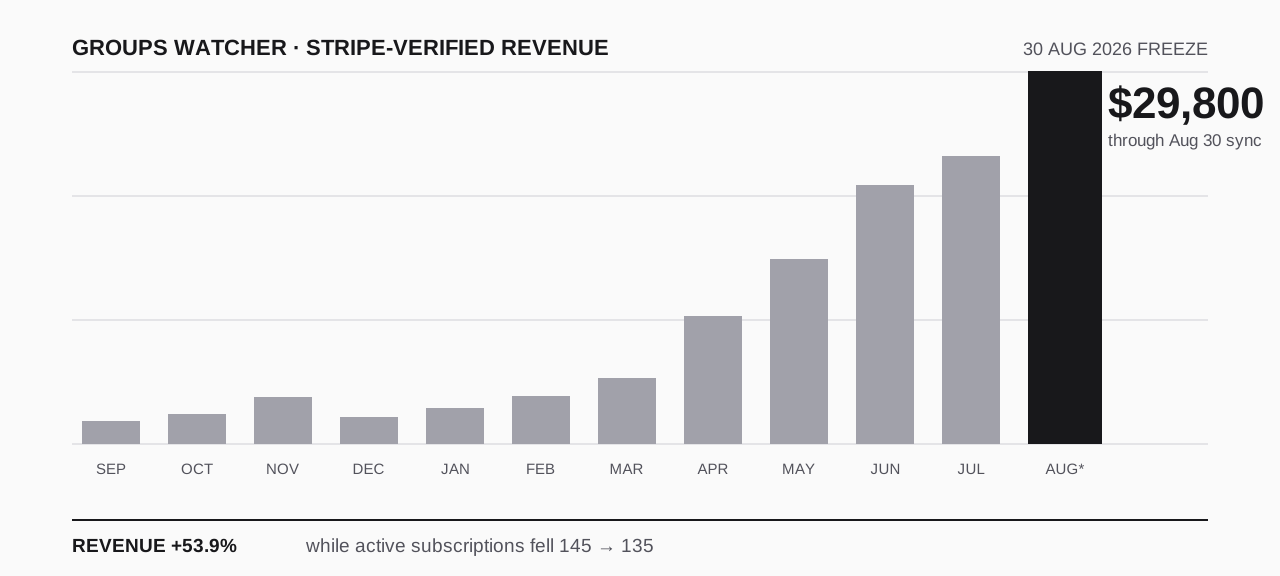
Groups Watcher's August revenue rose 53.9% while active subscriptions fell. Its product history explains the paradox: an alert extension became managed monitoring, then, by August, a done-for-you lead service.

A course teaching one arborist exam earns $35,683 a month on a domain Google sends no traffic to. Then the founder cloned it in Spanish — same product, same instructor — and it made $278. Here is what that proves.
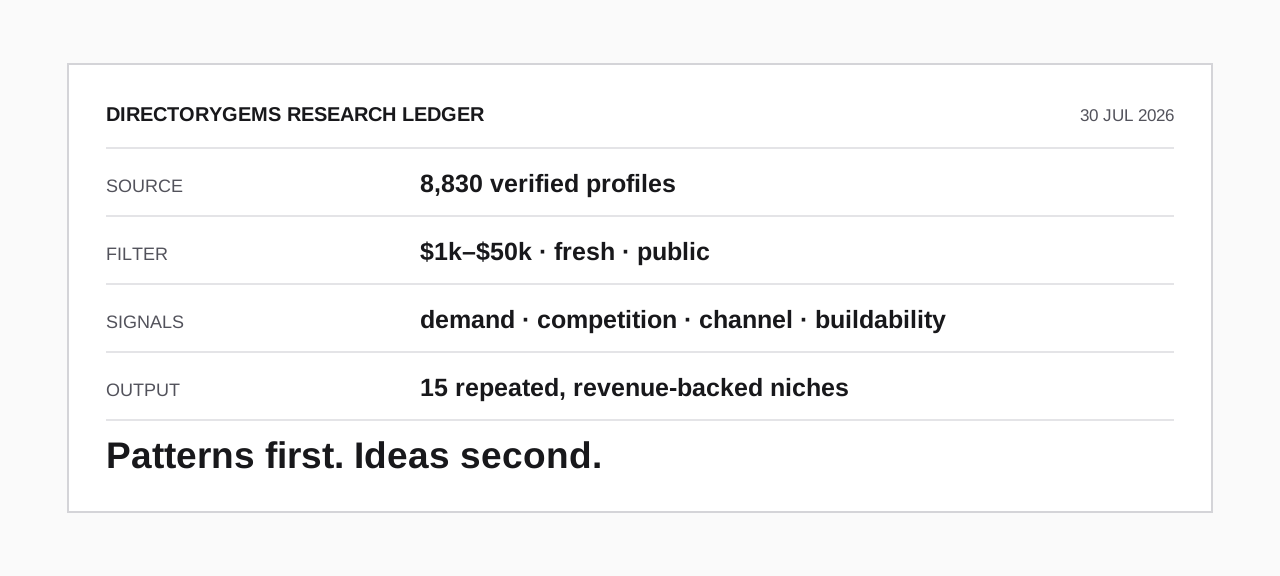
Most micro SaaS idea lists are invented. These 15 are each backed by named companies whose revenue is read from Stripe and RevenueCat APIs — with the exact revenue, domain rating and follower count behind every one.
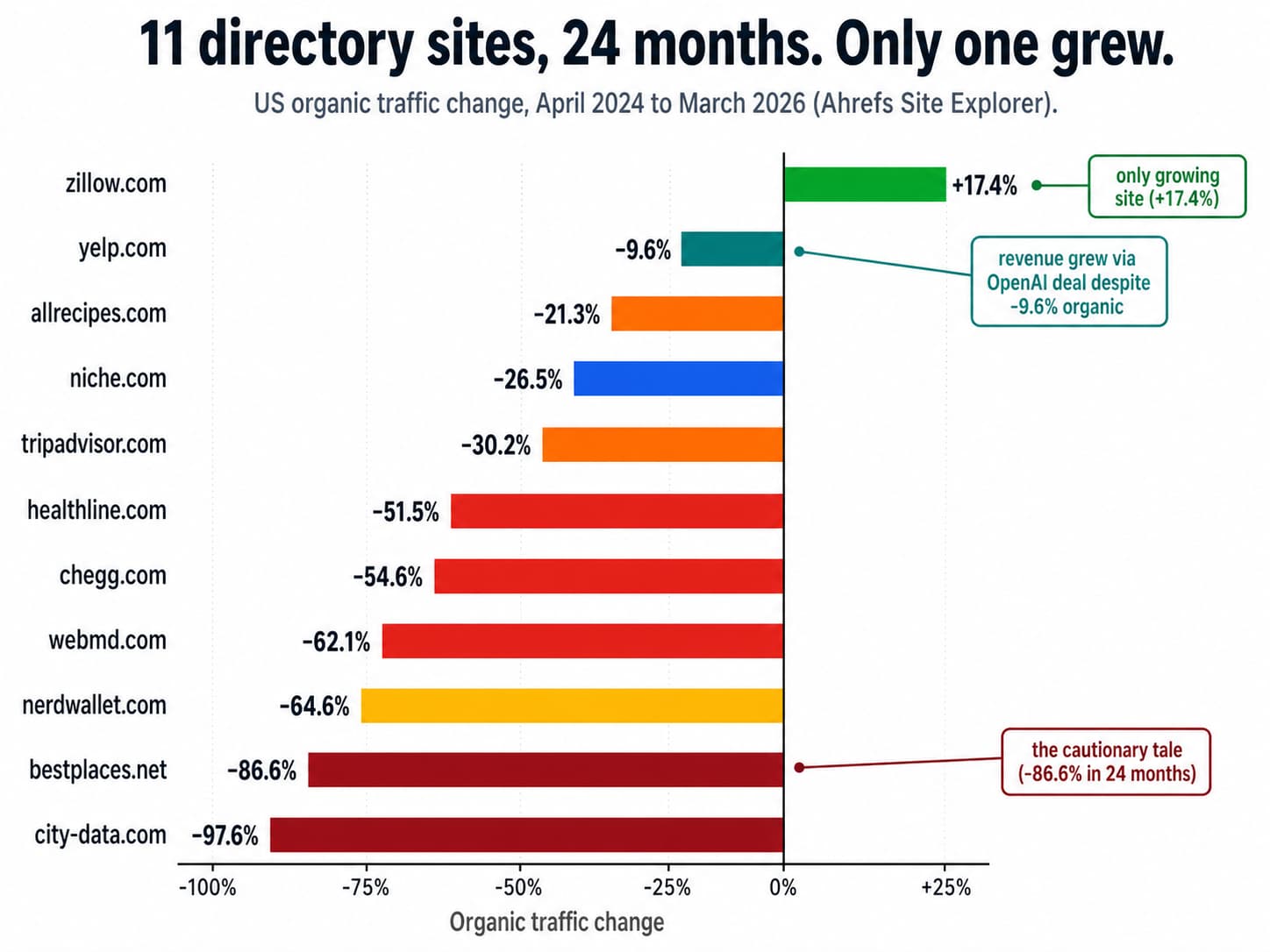
Of 11 directory sites audited against Ahrefs in April 2026, only Zillow grew. Two-thirds lost 21–98%. Six repeatable patterns separate winners, decoupled survivors, and dying directories.