- Where the numbers come from
- What Groups Watcher sells today
- The three product transitions
- The revenue curve changed before the homepage did
- Search did not build this business
- This is a category, not a Facebook trick
- The unit economics work when one lead is expensive
- The evidence that customers value it is promising, not conclusive
- The biggest risk is outside the codebase
- What to copy
- What not to copy
- The verdict
- Where the numbers come from
- What Groups Watcher sells today
- The three product transitions
- The revenue curve changed before the homepage did
- Search did not build this business
- This is a category, not a Facebook trick
- The unit economics work when one lead is expensive
- The evidence that customers value it is promising, not conclusive
- The biggest risk is outside the codebase
- What to copy
- What not to copy
- The verdict
Groups Watcher: $29,800 Collected Selling a 60-Second Head Start
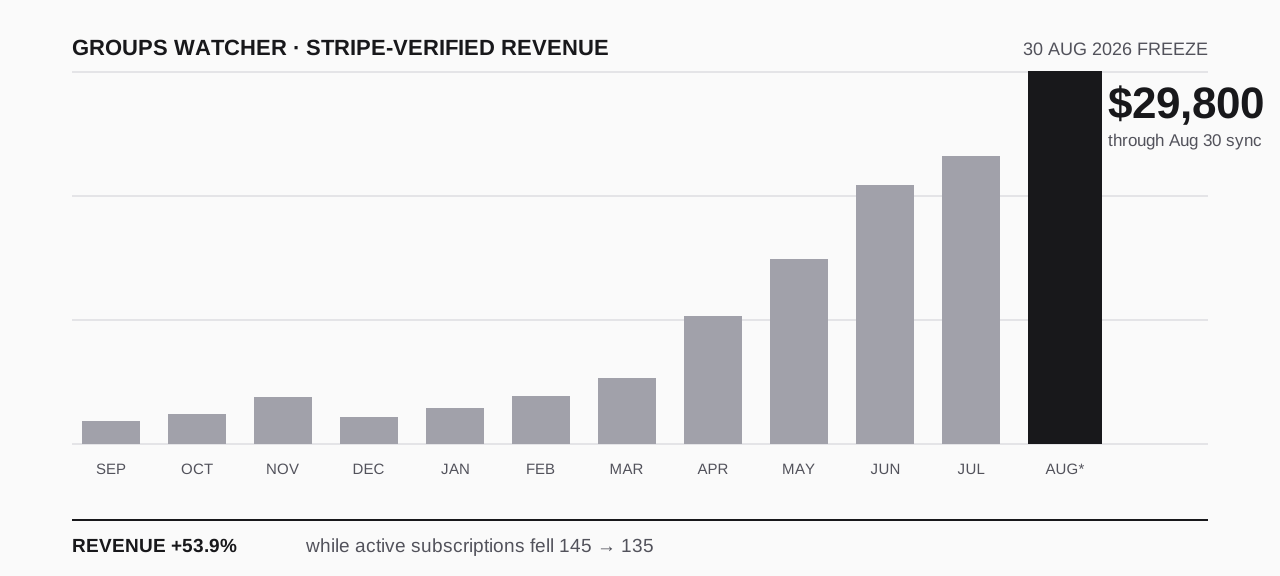
Through its August 30 payment sync, Groups Watcher collected $29,800 while the snapshot showed fewer active subscriptions than it had on July 31.
That sounds impossible until you separate three numbers founders routinely collapse into one:
- Calendar revenue rose from $19,366 in July to $29,800 through the August 30 sync: up 53.9%.
- MRR moved from $23,454 to $24,113: up only 2.8%.
- Active subscriptions fell from 145 to 135: down 6.9%.
This is not a story about ten more customers arriving. It is not even clean evidence of a 54% increase in recurring revenue. It is a story about a product changing what it completes for the buyer.
Groups Watcher began as a Chrome extension that notified you when somebody posted the right words in a Facebook group. The company then moved monitoring onto its own servers and accounts. Its current site still sells alerts, but it also offers to find the groups, monitor the conversations, identify local-service requests and comment on the customer's behalf.
The software used to say: here is the opportunity; go act. The new service says: we acted while the opportunity was still warm.
| Measure | July 31 | Aug 30 | Change |
|---|---|---|---|
| Calendar revenue | $19,366 | $29,800* | +53.9% |
| MRR | $23,454 | $24,113 | +2.8% |
| Active subscriptions | 145 | 135 | −6.9% |
| MRR / active subscription proxy | $161.75 | $178.61 | +10.4% |
*August is the calendar month through TrustMRR's 30 August 2026 12:10 UTC sync, not a completed month. July calendar revenue comes from TrustMRR's current historical timeline; the July MRR and subscription values come from our 31 July freeze. MRR per subscription is a directional ratio, not a disclosed plan average.
Where the numbers come from
Every payment number above comes from Groups Watcher's public TrustMRR profile. TrustMRR says the account is connected to Stripe by API key and that its revenue, MRR and subscription figures are calculated from the payment provider's records—not a screenshot or a number typed into a profile.
We froze the current page on 30 August 2026 at 08:47 PDT. TrustMRR's underlying revenue sync was 12:10 UTC that day. It showed $29,800 for both August-to-date and the rolling last 30 days, $112,601 all time, $24,113 in MRR and 135 active subscriptions.
We also retained the complete July 31 profile inside the 8,830-company dataset behind our 15 proven micro SaaS niches. That older snapshot is what makes the subscription comparison possible.
The source has limits. Stripe verifies that money changed hands; it does not publicly explain each charge. We cannot see how much came from the $199 alert plan, a $1,500 local-service engagement, annual prepayment, setup work, a refund, or another custom arrangement. We can observe the payment pattern. We cannot reverse-engineer a private general ledger from it.
What Groups Watcher sells today
Facebook groups contain unusually strong commercial signals. A homeowner does not search a broad phrase like “air conditioner information.” They ask their neighbors, “Who can repair my AC today?” The need, location and purchase timing arrive in the same sentence.
The problem is not finding intent in the abstract. It is seeing that one post before five competitors do.
Groups Watcher's Professional plan is publicly priced at $199 a month, with a $49 first month, and includes 10 groups. The company monitors selected public or private groups through its own accounts, applies keyword and intent filters, and sends alerts by email, Slack, Teams, Discord, mobile push or webhook. The page advertises delivery within 60 seconds. It explicitly says this plan is alerts only, with no automatic commenting.
Beside it sits a materially different product. The same page describes a done-for-you local lead-generation service from $1,500 a month covering 300 public groups. The team finds the groups, watches for requests and comments within seconds on the customer's behalf. The homepage aims this at family-owned local-service companies and says territory is exclusive to one company per niche and county.
That is not simply a more expensive feature tier. It moves Groups Watcher across the boundary from software into operations.
| Professional | Done-for-you local service | |
|---|---|---|
| Public price | $199/month; $49 first month | From $1,500/month |
| Coverage shown | 10 public or accessible private groups | 300 public groups |
| Output | Filtered alerts | Lead found and comment posted |
| Customer still does | Responds, qualifies and sells | Qualifies and sells after the first response |
Offer details are observations from the company's public page, not independently tested performance claims. Availability and pricing can change.
The three product transitions
The company documented the first two transitions itself in an update titled “Moving Away from the Extension to Managed Monitoring”.
The extension. Groups Watcher launched in 2024 as a Chrome extension. The customer used a personal Facebook account, had to belong to each target group and had to leave a computer online. The company's retrospective says alerts often took three to seven minutes, keyword matches were noisy and some users missed roughly 15% of posts. Those performance figures are company claims, but the operational constraint is obvious: the product depended on the customer's device and account.
Managed monitoring. In 2025, Groups Watcher began moving the work onto its servers and accounts. Customers no longer had to keep a browser open or share a login. The company handled group access and used contextual scoring rather than keywords alone. The advertised alert time dropped below 60 seconds.
Done-for-you response. The current local-service offer goes past detecting the post. Groups Watcher says it comments within seconds, so the customer's name appears while the recommendation request is still active.
Each transition removes a different failure point:
- The extension could fail because the customer's machine was offline.
- Managed monitoring could work perfectly and still fail because the customer replied too slowly.
- Done-for-you response removes that delay too.
The moat is not “AI scans Facebook.” Context classification is increasingly cheap. The harder system is the operational one: accounts with access, group coverage, local and niche exclusivity, fast routing, and a team willing to own the response window.
The revenue curve changed before the homepage did
The verified monthly sequence makes the shift visible without pretending to show causation:
Revenue went from $1,603 in September 2025 to $29,800 through August 30, 2026—an 18.6× increase. The inflection is April: $4,449 in March became $8,610, then $12,435 in May and $17,391 in June.
But the August payment shape is not a smooth row of identical $199 charges. Four days—$3,088 on August 3, $2,130 on August 10, $4,500 on August 23 and $3,030 on August 27—accounted for 42.8% of the month-to-date total. August revenue also sat $5,687 above current MRR.
That pattern is consistent with annual payments, setup fees, custom work or higher-priced service collections. It does not tell us which. This distinction matters because a founder could otherwise look at $29,800, label it “MRR,” and learn the wrong lesson.
What we can safely say is narrower and more useful: collected revenue accelerated without a matching increase in recurring run rate or subscription count, at the same time the public offer expanded beyond alerts into managed lead generation.
Search did not build this business
We ran one minimal live Ahrefs check on August 30. It estimated:
- Domain Rating 11
- 20 US organic keywords
- 56 estimated US organic visits a month
- 0 paid keywords
Ahrefs estimates are directional, not server logs. TrustMRR's last imported SEO value was DR 6 on August 27, a small difference likely caused by sync timing or reporting mode. Neither reading changes the conclusion: a site with roughly 56 estimated search visits is not acquiring enough buyers through Google to explain roughly $30,000 in 30-day payment volume.
This follows the same distribution pattern as Tree Nerd Academy, but the mechanism is different. Tree Nerd borrowed trust from a professional community. Groups Watcher turns the community's own posts into the product. In both cases Google is downstream of the real market, not the source of it.
The company lists blog and SEO as channels on TrustMRR, and it publishes detailed product articles. Those pages can help a buyer validate the service. The evidence does not support calling search its acquisition engine.
This is a category, not a Facebook trick
In the July corpus, 10 payment-verified winners matched the broader alert pattern. Their median monthly revenue was only $1,998, median DR was 3, 90% had a small recorded X audience, and the average positive revenue streak was 6.8 months.
Two adjacent examples show the shape:
- NextjobConnect monitored neighborhood platforms for home-service job requests. At the July freeze it had $7,932 MRR, 34 active subscriptions, DR 3 and no recorded X following.
- TruckerDB sold daily carrier-lead and insurance-renewal alerts to trucking-adjacent businesses. It had $1,484 MRR, 16 active subscriptions and a public $129 monthly plan.
The reusable category is time-sensitive, already-expressed demand. A source produces a signal. Software filters it. A narrow professional buyer pays because acting first is worth more than the subscription.
Groups Watcher pushed that model one step further. Once the alert is fast enough, the remaining delay belongs to the customer. So the company began selling the response.
The unit economics work when one lead is expensive
A $199 alert product is difficult to sell if the underlying transaction is worth $40. It is easy to understand if one roof, HVAC replacement, plumbing emergency or agency contract is worth thousands.
The relevant calculation is not “How much does an alert cost?” It is:
Expected gross profit from one extra job × probability the service helps win it − service price.
That lets Groups Watcher price far above a generic notification app while serving a small audience. The done-for-you tier intensifies the logic. At $1,500 a month, the customer does not need hundreds of leads. A handful of won high-ticket jobs can make the service rational.
This is also why speed is part of the product rather than a performance detail. In an ordinary analytics tool, a five-minute delay is irrelevant. In a neighborhood recommendation thread, five minutes can be the entire market.
The evidence that customers value it is promising, not conclusive
Groups Watcher's Trustpilot page showed 15 reviews and a 4.5 TrustScore when checked on August 30. All 15 were in the prior 12 months and the displayed rating distribution was 100% five-star. Several reviewers described winning leads by replying early, while others emphasized support and reliability.
That is a useful independent signal, but a small and self-selected one. Trustpilot says the company invites reviews. Fifteen positive reviewers cannot establish average lead volume, retention, payback or ROI across 135 active subscriptions. The reviews show that real customers report the intended outcome. They do not tell us how typical it is.
The company's own claims—under-60-second delivery, being first 99% of the time, or producing five times more opportunities after the managed transition—should be read the same way: they describe the pitch and internal observation, not an audited benchmark.
The biggest risk is outside the codebase
Groups Watcher says it uses its own Facebook accounts and does not ask customers for credentials. For private groups, it says monitoring works only when one of its accounts can access the group. That removes risk from the customer's personal account, but it does not remove the business's dependence on Facebook, group administrators or account access.
Meta describes scraping as automated data collection and distinguishes between authorized and unauthorized collection. It also describes rate limits, detection, blocking and enforcement against unauthorized scraping. The public record we reviewed does not establish whether Groups Watcher has authorization from Meta. It would be irresponsible to claim either that the company violates policy or that platform access is assured.
The structural risk exists either way:
- Facebook can change interfaces, access rules or enforcement.
- Group administrators can refuse or remove monitoring accounts.
- The service becomes harder as it expands into more counties and private communities.
- Done-for-you comments introduce quality, disclosure and brand-safety work that alerts do not.
The company's August 2026 terms prohibit illegal activity, harassment, impersonation and deception. That is good policy language. Operations still have to enforce it across every account and response.
This is the trade: the operational layer justifies the higher price and creates the moat; it also creates the concentration and execution risk.
What to copy
Start with a signal whose value decays quickly. “A business mentioned your category” is weak. “A homeowner in your county needs your exact trade today” is a product.
Measure the cost of the remaining customer action. If customers receive the alert but respond late, the job is not complete. That failure is an expansion opportunity.
Price against the transaction, not the notification. A fast lead for a $10,000 job can support service pricing. A fast lead for a $30 purchase cannot.
Use software to create an operations advantage. The extension proved demand cheaply. Managed infrastructure improved coverage. Human or managed response monetized the last mile. Do not begin with 300 groups and a service team before the alert itself has buyers.
Keep the offer boundaries explicit. “Alerts only” and “we comment for you” create different expectations, risks and gross margins. Mixing them under one SaaS number will hide what actually works.
Treat source access as inventory. The valuable asset is not a list of keywords. It is reliable, legitimate access to the places where high-intent requests appear.
What not to copy
Do not infer that “AI social listening” is automatically valuable. Most mentions do not carry money or urgency. The niche works because a recommendation request exposes buyer, timing, location and category at once.
Do not call payment volume recurring revenue. Current MRR is $24,113, not $29,800. The public numbers do not disclose plan mix or service margin.
Do not build a business that requires undisclosed or unauthorized platform access. The source-access strategy has to survive policy review, group rules and account loss.
And do not assume a service layer is free growth. Removing customer work transfers that work—and its mistakes—to the vendor.
The verdict
Groups Watcher is interesting because the visible technology is not novel. Monitoring, keyword matching, classification and webhooks are all reproducible.
What is harder to reproduce is the system around them: source access, sub-minute delivery, local coverage, response operations and a price tied to an urgent, high-value job.
The payment record is not proof that every service business should abandon SaaS. Groups Watcher still sells a $199 software plan. It is evidence for a more precise rule:
When the value of a signal expires in minutes, the highest-value product may be the one that acts on it—not the one that merely sends it.
That is how a low-authority site with 87 recorded X followers can collect $29,800 before August is over. Not by winning attention at scale. By owning sixty seconds inside a market that is already asking to buy.
Research frozen 30 August 2026. Payment figures are Stripe-verified through TrustMRR; August was incomplete at the stated sync. Ahrefs metrics are estimates. Product details and performance claims can change; company-reported claims are labeled rather than treated as independently verified.
Related reading: the 15 proven micro SaaS niches behind this series · Tree Nerd Academy's zero-search distribution · how TrustMRR's verified revenue directory works
Frequently asked questions
What is Groups Watcher?
Groups Watcher monitors Facebook groups for relevant posts and sends alerts when a post matches a customer's keywords or intent. Its public offers now include a $199-per-month Professional alert plan and a done-for-you local lead-generation service advertised from $1,500 per month. The company says the product began as a Chrome extension in 2024 and moved toward managed monitoring in 2025.
How much revenue does Groups Watcher make?
TrustMRR showed $29,800 of Stripe-verified revenue for August 2026 through its August 30 sync, the same amount for the rolling last 30 days, $24,113 in current MRR, 135 active subscriptions, and $112,601 all time. August 30 was a partial day and the calendar month was not complete.
How did Groups Watcher grow while subscriptions fell?
Between the July 31 and August 30 snapshots, calendar revenue rose 53.9%, MRR rose only 2.8%, and active subscriptions fell 6.9%. The current site combines recurring software with a higher-priced managed service, but public payment summaries do not disclose plan mix, setup fees, annual prepayments, or custom invoices. The figures show a hybrid payment pattern; they do not prove which charge type caused the increase.
Does Groups Watcher get customers from SEO?
Search is too small to explain the business. A limited live Ahrefs check on August 30 estimated 56 monthly US organic visits from 20 keywords and no paid keywords. Ahrefs estimates are directional, but this result rules out Google as the main source of roughly $30,000 in monthly payment volume.
What is the main risk in the Groups Watcher model?
The service depends on continued access to third-party Facebook groups, approvals for company-controlled accounts, and platform rules and enforcement. Groups Watcher says it uses its own accounts and monitors a private group only when one of those accounts can access it. Public sources do not establish its authorization status with Meta, so this case study does not claim either compliance or illegality.
Related Case Studies

A course teaching one arborist exam earns $35,683 a month on a domain Google sends no traffic to. Then the founder cloned it in Spanish — same product, same instructor — and it made $278. Here is what that proves.
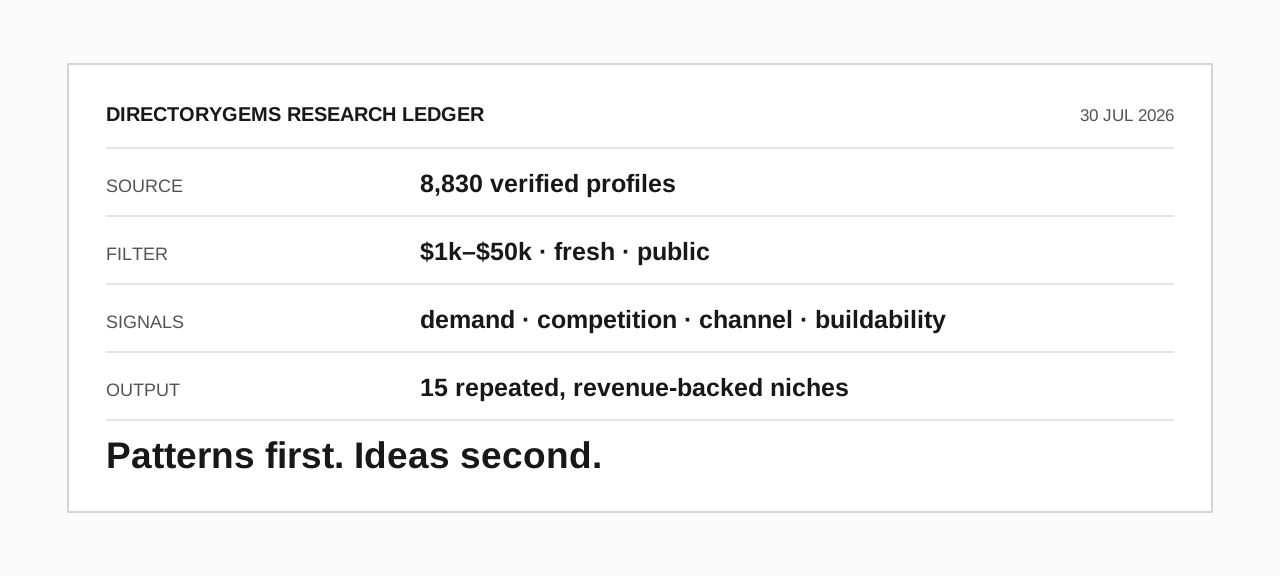
Most micro SaaS idea lists are invented. These 15 are each backed by named companies whose revenue is read from Stripe and RevenueCat APIs — with the exact revenue, domain rating and follower count behind every one.
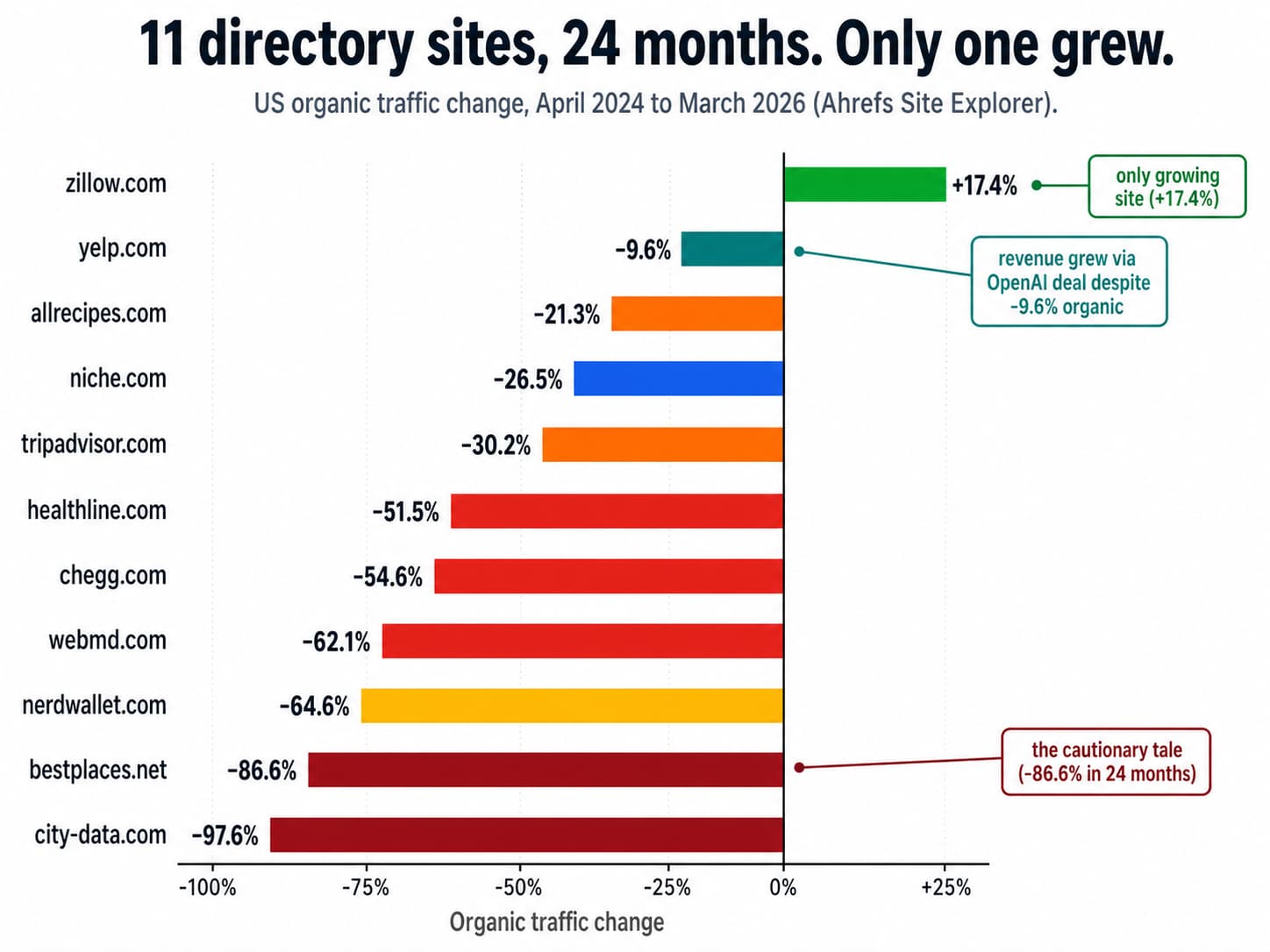
Of 11 directory sites audited against Ahrefs in April 2026, only Zillow grew. Two-thirds lost 21–98%. Six repeatable patterns separate winners, decoupled survivors, and dying directories.
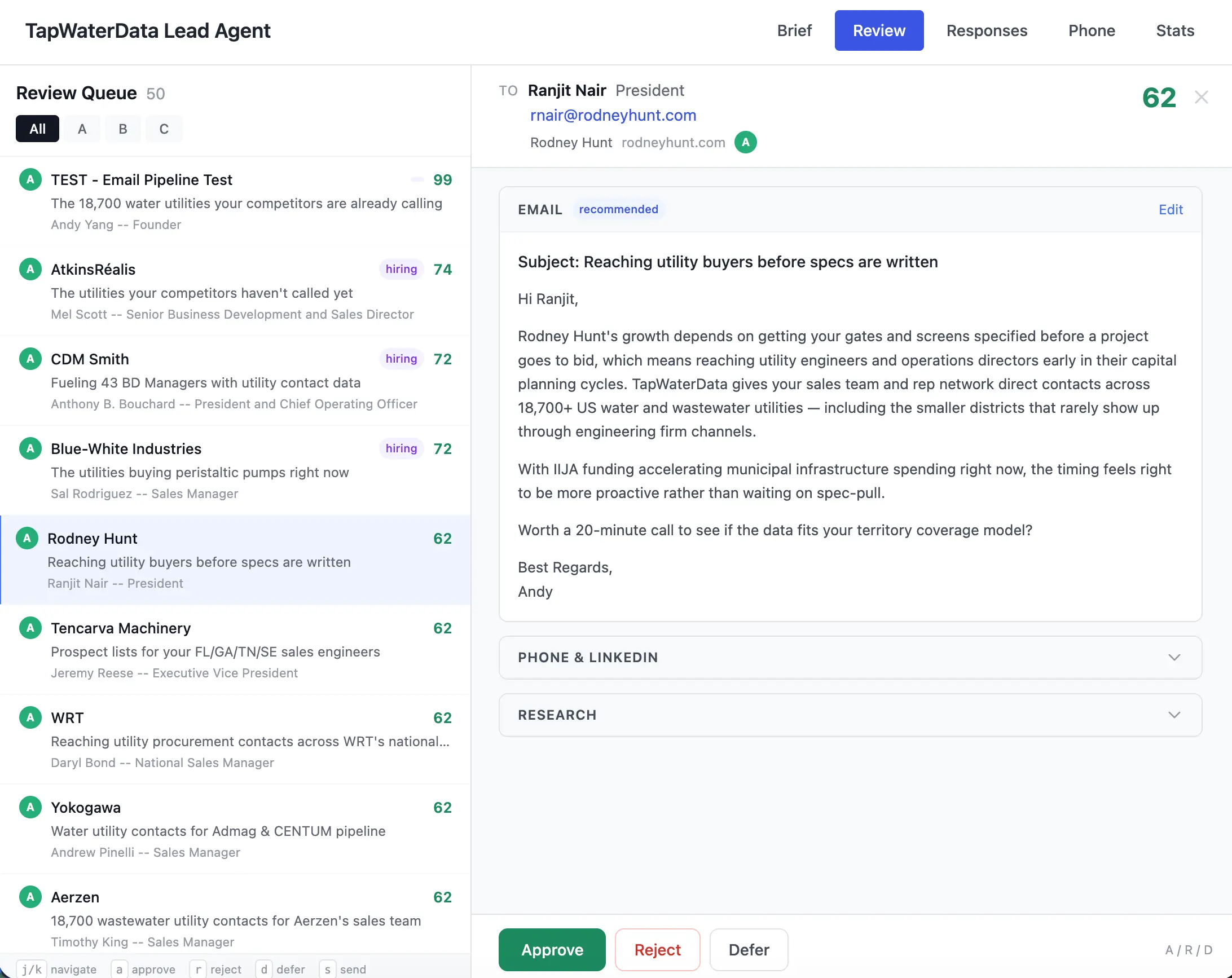
I described what I wanted and Claude Code built an 8,800-line AI sales agent in one session. 665 prospects, 60% open rate, $27/week. Here's the full breakdown.