- Where these numbers come from
- What it actually sells
- The part that should not work
- So where do the customers come from?
- The conversion engine: give away the diagnostic
- The clone: an accidental controlled experiment
- How rare is this, really?
- The fragility nobody puts in the screenshot
- What you can actually copy
- The one-line version
- Where these numbers come from
- What it actually sells
- The part that should not work
- So where do the customers come from?
- The conversion engine: give away the diagnostic
- The clone: an accidental controlled experiment
- How rare is this, really?
- The fragility nobody puts in the screenshot
- What you can actually copy
- The one-line version
Tree Nerd Academy: $35,683/Month With Zero Google Traffic
In March 2026, the founder of a $35,000-a-month business ran the experiment most teardowns can only speculate about. He cloned it.
Same course. Same instructor. Same video lessons, same practice engine, same pass guarantee, same page layout. Translated into Spanish, priced 30% cheaper, on a domain with a better backlink profile than the original.
Five months later the original earns $35,683 a month. The clone earns $278.
That is a 128x gap between two versions of what is essentially the same product, run by the same person, at the same time. Almost nothing in indie business writing gives you a controlled experiment. This one does, and it settles an argument that usually gets settled by opinion.
$35,683
Last 30 days, Stripe-verified
$169,396
All-time, in 8.6 months
0
Organic visits from Google
99
Founder's X followers
Where these numbers come from
Every revenue figure here comes from TrustMRR, a public directory where founders connect their Stripe, RevenueCat, Paddle, Lemon Squeezy or Polar account so the site displays revenue read straight from the payment processor. There is no field to type a number into.
On 30 July 2026 we downloaded every public profile on that site — all 8,830 of them, not a sample — which is the dataset behind our 15 proven micro SaaS niches. This article re-checked Tree Nerd Academy's live profile, both websites and their search data on 23 August 2026, so the headline figures are current rather than three weeks stale.
Two terms you will see throughout. DR is Ahrefs Domain Rating, a 0–100 logarithmic score of how strong a site's backlink profile is: 0 is a brand-new domain, 100 is Wikipedia. Followers means the founder's X/Twitter count only, measured today — it misses LinkedIn, YouTube and email lists, which matters here more than usual.
What it actually sells
Tree Nerd Academy prepares people for exactly one exam: the ISA Certified Arborist Exam, the main professional credential for people who work on trees. Not "tree care education." Not "green industry certification." One exam.
For a one-time payment you get 6+ hours of video, 100+ text lessons, 4,500+ practice questions and flashcards, unlimited mock exams weighted across all 10 exam domains, an arborist-trained AI tutor, a glossary, and a 60-day study plan with a 30-day fast track for working arborists.
The pricing ladder is three rungs:
| Tier | Price | Note |
|---|---|---|
| Starter | $60 | Entry rung |
| Self-Study Protocol | $199 | Headline offer, marked "launch price, returns to $249" |
| Inner Circle Edition | $229 | Adds community and support |
The verified data lets us check what customers really pay. All-time revenue of $141,488 across roughly 612 users at the July pull works out to an average order of $231 — landing exactly where you would expect if most buyers take the $199 tier and a meaningful minority upgrade to $229. The pricing page is not decoration; it describes what actually happens.
Access is lifetime, one-time, and the site attacks the alternatives by name. Its comparison table sets $199-forever against TreeU at "$150, recurring, 30 days ONLY" and against local chapter courses at "$300–$500 per event, live only." The framing is stop renting your education — a deliberate strike at time-boxed competitors, and a smart read of a buyer who takes the exam once.
The guarantee is the other half of the offer: pass or get a full refund. The conditions are specific — complete at least 90% of lessons, watch all videos, supply valid results showing you did not pass, request within 30 days of the exam. That design removes the purchase risk while quietly limiting abuse and generating completion data.
The part that should not work
Here is where this stops being an ordinary course business.
We checked treenerdacademy.com in Ahrefs on 23 August 2026. The result:
0
Organic keywords ranking
0
Monthly organic visits
0
Paid keywords / ads
7
Domain Rating (of 100)
No search traffic. No ads. A backlink profile barely distinguishable from a domain registered last week.
The instinctive reaction is that they are leaving money on the table and should invest in SEO. So we sized the prize. Here is the entire search market for this exam, US monthly volume with Ahrefs keyword difficulty (KD 0 means the pages ranking have almost no backlinks — as easy as SEO gets):
| Keyword | US volume | KD | Intent |
|---|---|---|---|
| isa certified arborist | 1,000 | 24 | Informational |
| arborist certification | 600 | 1 | Informational |
| how to become a certified arborist | 300 | 2 | Informational |
| isa certified arborist study guide | 70 | 0 | Buying |
| isa certified arborist practice test | 60 | 0 | Buying |
| certified arborist practice test | 40 | 0 | Buying |
| isa exam | 50 | 10 | Mixed |
| isa arborist exam | 20 | 10 | Mixed |
| arborist exam prep | 0 | — | No measurable demand |
The entire buying-intent cluster is about 170 searches a month. Not 170,000. One hundred and seventy.
Rank first for every commercial term in the niche, win every click, convert every visitor into a $199 customer, and you top out around $34,000 a month — roughly what this business already makes, at a conversion rate that does not exist. Search was never going to build it. Tree Nerd Academy is not neglecting SEO; SEO is structurally incapable of producing this business.
One number in that table is the tell. "tree nerd academy" gets 100 US searches a month — 150 worldwide. The brand name out-searches every non-branded commercial term in its own category. People are not discovering this product through Google. They already know the name by the time they type it, and Google is just the address bar.
So where do the customers come from?
From a person.
Herman Palmgren, the founder, is a developer in Sweden with 99 X followers and no arboriculture background. What he has is a partner: Chris Comer, an ISA Board Certified Master Arborist with nearly 20 years in the industry who, in his own words, has already "educated hundreds of certified arborist test takers."
Chris is not a hired presenter. He is the masthead. He teaches every video, bylines the blog, and the site offers to let you book a call with Chris and chat with Chris. The credibility problem in a market where a wrong answer costs you a $300 exam fee and a re-sit is solved by putting a named, credentialed human in front of it.
That partnership explains the revenue curve, which is not the gentle ramp founders expect:
Monthly revenue, Stripe-verified
"30d" is the rolling 30 days to 23 August 2026, not calendar August. April–May shown in red: revenue fell 33% from March and took three months to recover.
January is $466 — a soft open. February is $18,832. That is not a product finding a market; that is a product being introduced to a market that already existed, inside Chris's own pipeline of students and the ISA study groups on Facebook where candidates gather. Distribution was not built. It was borrowed, from someone who had spent twenty years accumulating it.
Around that core sit the ordinary mechanics: YouTube and Instagram content, testimonials harvested from study-group threads, and an affiliate program that lets niche arborist channels and gear shops sell it for a cut. All of them are community-shaped. None of them are search.
The conversion engine: give away the diagnostic
The single best-designed thing on the site is free, and it is not a lead magnet in the usual sense.
Tree Nerd offers a 100-question practice exam, 105 minutes, weighted across all 10 real exam domains — the actual pacing of the certification test. No payment. No signup. At the end you get a domain-by-domain breakdown of where you are weak.
Read what that does. A candidate who has never met this brand takes a full-length mock, discovers in 105 minutes that they are shaky on tree biology and soil science, and now holds a personalised, specific, uncomfortable diagnosis — produced by the product itself. The course stops being a $199 purchase and becomes the obvious fix for a problem they just watched themselves have. It proves quality, creates urgency and pre-sells the curriculum in one artifact.
Most founders would gate that behind an email. Tree Nerd gives it away outright, because the diagnosis is the pitch.
The clone: an accidental controlled experiment
Now back to where we started, because this is the part worth the whole article.
In March 2026 Herman launched TreeNerdAcademia.com — the same course in Spanish. Same instructor, same structure, same guarantee, same funnel design, priced at $139 instead of $199. Its Domain Rating is 9, slightly better than the original's 7. It is linked prominently from the English site's FAQ.
Five months of results, both verified through Stripe on the same day:
Last 30 days to 23 August 2026
The Spanish bar is drawn to scale. All-time: $169,396 vs $1,808.
128 times the revenue, for the version that isn't cheaper, isn't better-linked, and isn't technically different.
Every explanation a founder would normally reach for is ruled out by the design of the experiment. It is not the product — identical. Not the price — the loser is cheaper. Not the domain authority — the loser is higher. Not the funnel, the guarantee, the positioning or the founder's skill — all held constant. Not even time: over its own first five months of trading the English site earned $70,777, against the Spanish site's $1,808 over the same stretch of its life.
What did not come along was Chris Comer's twenty years of standing among English-speaking arborists, and the Facebook study groups those candidates live in. The clone shipped the software and the translation. It could not ship the trust, because trust is held by a person inside a specific community, and it does not localise.
If you have ever wondered whether "distribution beats product" is a real claim or a slogan, this is as close to a laboratory result as this industry produces. The same founder ran both arms. One had a relationship. It earned 128 times more.
The reusable lesson
A course business does not sell information — information is free and getting freer. It sells a trusted person's judgement about what will be on the test. The software is the delivery mechanism, and the delivery mechanism is the cheap half. When Tree Nerd cloned the cheap half, it got 0.8% of the business.
How rare is this, really?
Against the full 8,830-company dataset, Tree Nerd is genuinely exceptional — worth saying plainly, because survivorship stories are easy to mistake for typical ones.
- It ranks #105 of the 1,295 companies earning $1,000/month or more, and beats 98.9% of all 8,830 profiles.
- It reached this in 7.8 months. The median company earning over $1,000/month is 15.5 months old. Only 12 of 1,087 dated winners hit $37,000/month inside nine months.
- It is, as far as the corpus shows, the only professional-exam-prep business in all 8,830 profiles — no one else is doing this, which is exactly why the niche was open.
That last point is the actionable one. The reason a first-time founder with 99 followers could take a market is that no modern product had bothered to show up. The competition was a $150 monthly rental with quizzes in Google Forms, and $300–500 live Zoom sessions.
The fragility nobody puts in the screenshot
This business has a structural weakness that the headline number hides completely.
MRR: $0. Active subscriptions: none. Every dollar is one-time. There is no contracted floor, no renewal base, nothing that arrives whether or not anyone shows up next month. That $35,683 is rebuilt from zero every thirty days, roughly 155 strangers at a time.
It is not a rare model — 273 of the 1,295 winners (21.1%) have no recurring revenue at all — but it changes what the number means. A $35,000 subscription business and a $35,000 one-off business are not the same asset, and the second one is worth materially less when sold.
The other honest signals in the current data:
- Growth has flattened. The July snapshot showed +11.3% month over month. On 23 August, TrustMRR shows +1% against the prior period. Still near its peak, no longer compounding.
- The revenue is lumpy. March to April fell 33%, and it took three months to make it back. Exam-prep demand moves with test dates, not with your dashboard.
- Key-man risk is the business model. The whole thesis of this article is that Chris Comer's reputation is the asset. Assets that are also people can leave, renegotiate, or have a bad year.
- A ceiling exists. ISA certifies a finite number of arborists annually. Roughly 612 customers so far is already a real slice of the addressable pool, which is likely why the Spanish expansion was attempted in month four.
- Scrutiny is real. Study groups have publicly caught errors in the free practice test. Revenue kept climbing, which suggests fast fixes plus a refund guarantee absorb it — but in an exam market, accuracy complaints are the failure mode that compounds.
- Marketing claims move. On 1 August the page framed urgency as "60% fail first try"; today it reads "roughly 1 in 3 ISA exam candidates fail on their first attempt." Worth noting that the stat used to sell you was revised downward by half.
- Discount the social proof counters. The English site advertises "686 arborists in training," close to the ~612 users TrustMRR reports. The Spanish site advertises "429 arboristas en formación" — but $1,808 of all-time revenue at $139 implies roughly a dozen buyers. Whatever that counter measures, it is not customers.
What you can actually copy
The software is not the moat, so copying the software is not the plan. What transfers:
- Recruit the credential, don't fake it. Find the person a niche already trusts and give them equity or a revenue share. Herman's contribution was the engine; Chris's was the market. February's $18,832 was Chris's audience, not Herman's marketing.
- Pick a market too small for SEO to matter. A 170-searches-a-month keyword universe reads as a dead niche on a keyword tool and is exactly why nobody built a modern product there. Small search volume with high-stakes buyers is an opportunity signal, not a warning.
- Ship a free, full-length, realistic diagnostic. Not a 10-question teaser. Real length, real pacing, real domain weighting, no signup wall. Let the product deliver the bad news that makes the purchase obvious.
- Sell certainty, not access time. For a once-in-a-career exam, lifetime one-time beats monthly rental, and saying so explicitly — stop renting your education — converts against incumbents whose pricing punishes slow studiers.
- Reverse the risk, with conditions. Pass-or-refund removes the objection; requiring 90% completion and real exam results limits abuse and gives you completion data.
- Do not assume the engine travels. The clone is the warning. Before duplicating into a new language or market, ask what percentage of the original's revenue came from one person's relationships — because that is the percentage that will not come with you.
The one-line version
Tree Nerd Academy makes $35,683 a month from a market with 170 buying-intent searches, on a site Google ignores, because a developer with 99 followers rented twenty years of a master arborist's credibility and built a good enough product to put behind it.
Then he proved it himself: he shipped the same product without the credibility, and it made $278.
Method and caveats
Revenue is read from Stripe via TrustMRR and is revenue, not profit — Stripe fees, video production, the instructor's share, affiliate payouts and refunds all come out of these figures, and the profit margin is not disclosed. Corpus statistics come from all 8,830 public TrustMRR profiles downloaded 30 July 2026; company-level figures, both websites and all search data were re-checked on 23 August 2026. Search metrics are Ahrefs estimates for US and worldwide organic traffic and can understate very new pages. Follower counts are X/Twitter only. TrustMRR is self-selected — founders opt in — so it skews toward indie, Stripe-economy businesses and is not a census of software companies.
This is an independent analysis. We have no relationship with Tree Nerd Academy and were not asked to write it.
One verified business, taken apart, every week
This is issue 02 of a series built on 8,830 payment-verified startups. Each issue takes a single real business apart — what it charges, where the customers actually come from, and what you could copy by the weekend.
Get the next teardown →Related reading: the 15 proven micro SaaS niches behind this series · how TrustMRR itself works and makes money · how directory sites are surviving the AI era
Frequently asked questions
What is Tree Nerd Academy?
An online course that prepares candidates for one exam: the ISA Certified Arborist Exam. It sells 6+ hours of video, 100+ text lessons, 4,500+ practice questions and flashcards, unlimited mock exams and an AI tutor for a one-time $199, with lifetime access and a pass-or-refund guarantee. It was founded in December 2025 by Herman Palmgren in Sweden, with ISA Board Certified Master Arborist Chris Comer as the instructor.
How much money does Tree Nerd Academy make?
$35,683 in the 30 days to 23 August 2026, and $169,396 since launch — revenue read directly from its Stripe account through TrustMRR, not self-reported. It has no subscriptions at all: every dollar is a one-time purchase, so the monthly figure is rebuilt from zero each month.
How does Tree Nerd Academy get customers without SEO?
Ahrefs shows the domain ranking for essentially no keywords and receiving no organic search traffic as of 23 August 2026. The buyers come from the instructor's existing reputation among arborists, ISA study groups on Facebook, YouTube and Instagram content, and an affiliate program. The entire buying-intent search market for this exam is roughly 170 US searches a month, so search could not have produced this business even if the site ranked first for everything.
Why did the Spanish version of Tree Nerd Academy fail?
TreeNerdAcademia.com launched in March 2026 with the same product, the same instructor and a lower price ($139 vs $199), and has earned $1,808 in total — $278 in the last 30 days, against the English site's $35,683. That is a 128x gap on a near-identical product, which indicates the asset was never the software. It was the instructor's standing inside one English-speaking professional community, and that did not translate.
Can you copy a business like Tree Nerd Academy?
The software is the easy part and can be built in weeks. The hard part is the named expert whose reputation the market already trusts, plus access to the community where candidates gather. Tree Nerd's own Spanish clone is the cleanest available evidence: copying everything except the trust produced 0.8% of the revenue.
Related Case Studies
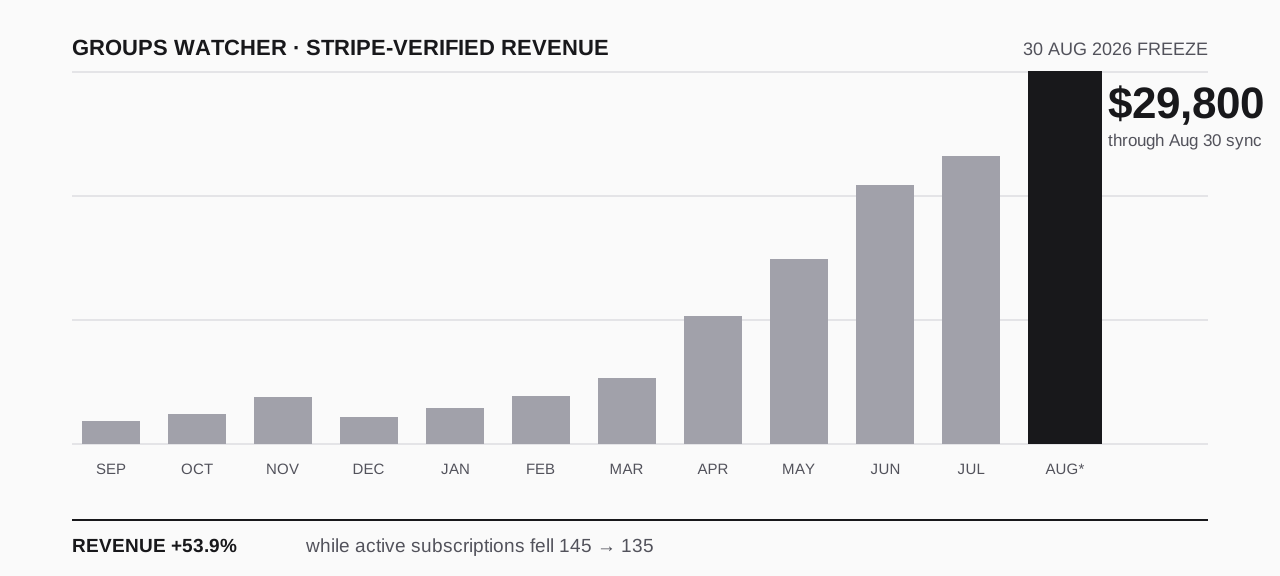
Groups Watcher's August revenue rose 53.9% while active subscriptions fell. Its product history explains the paradox: an alert extension became managed monitoring, then a done-for-you lead service.
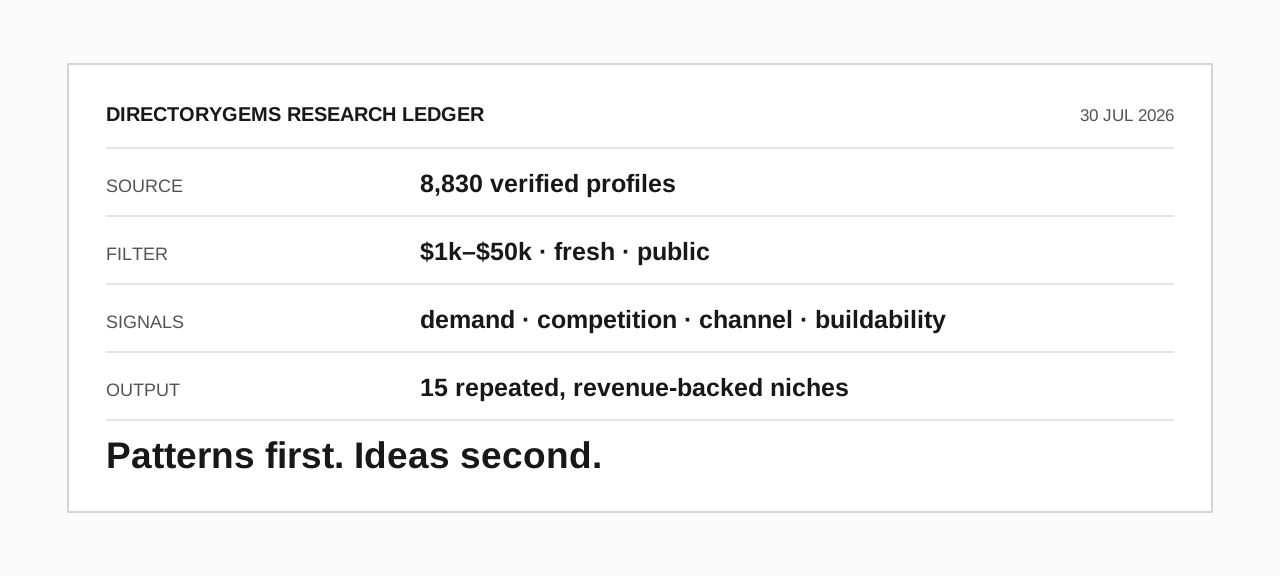
Most micro SaaS idea lists are invented. These 15 are each backed by named companies whose revenue is read from Stripe and RevenueCat APIs — with the exact revenue, domain rating and follower count behind every one.
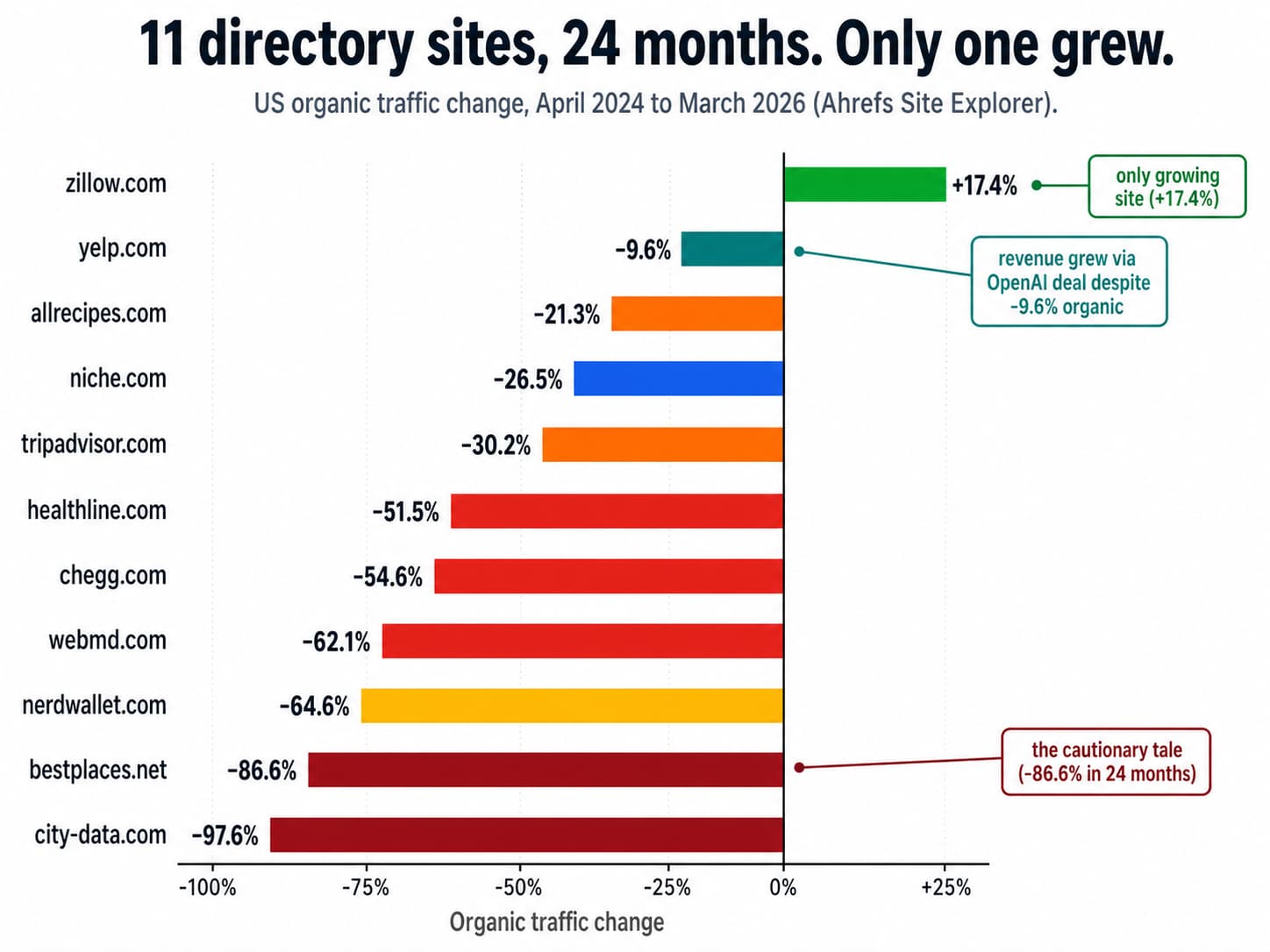
Of 11 directory sites audited against Ahrefs in April 2026, only Zillow grew. Two-thirds lost 21–98%. Six repeatable patterns separate winners, decoupled survivors, and dying directories.
I described what I wanted and Claude Code built an 8,800-line AI sales agent in one session. 665 prospects, 60% open rate, $27/week. Here's the full breakdown.