- How a niche earned its place on this list
- The 15 ideas at a glance
- Group A — Sell to someone with a deadline
- Group B — Attach yourself to a platform
- Group C — Sell intent, data and visibility
- Group D — Point AI at one specific job
- Group E — Serve one community properly
- Now the part idea lists leave out: your actual odds
- How to actually choose one
- Method, and what this data cannot tell you
- How a niche earned its place on this list
- The 15 ideas at a glance
- Group A — Sell to someone with a deadline
- Group B — Attach yourself to a platform
- Group C — Sell intent, data and visibility
- Group D — Point AI at one specific job
- Group E — Serve one community properly
- Now the part idea lists leave out: your actual odds
- How to actually choose one
- Method, and what this data cannot tell you
Micro SaaS Ideas: 15 Proven Niches From 8,830 Payment-Verified Startups
Almost every "micro SaaS ideas" list is invented. Somebody brainstormed plausible-sounding products and published them. Nobody checked whether a single human had ever paid for one.
This list works the other way around. We started with TrustMRR, a directory where founders connect their Stripe, RevenueCat, Paddle, Lemon Squeezy or Polar account through an API and the site displays whatever the payment processor reports. You cannot type in a number. In July 2026 we pulled all 8,830 public profiles, parsed 25 fields each, and looked for patterns where several unrelated founders were independently making real money.
Below are the 15 niches that survived. Every one names actual companies, with their verified monthly revenue, their domain rating, and their founder's follower count — so you can see not just that a niche works, but whether it works for someone starting from nothing.
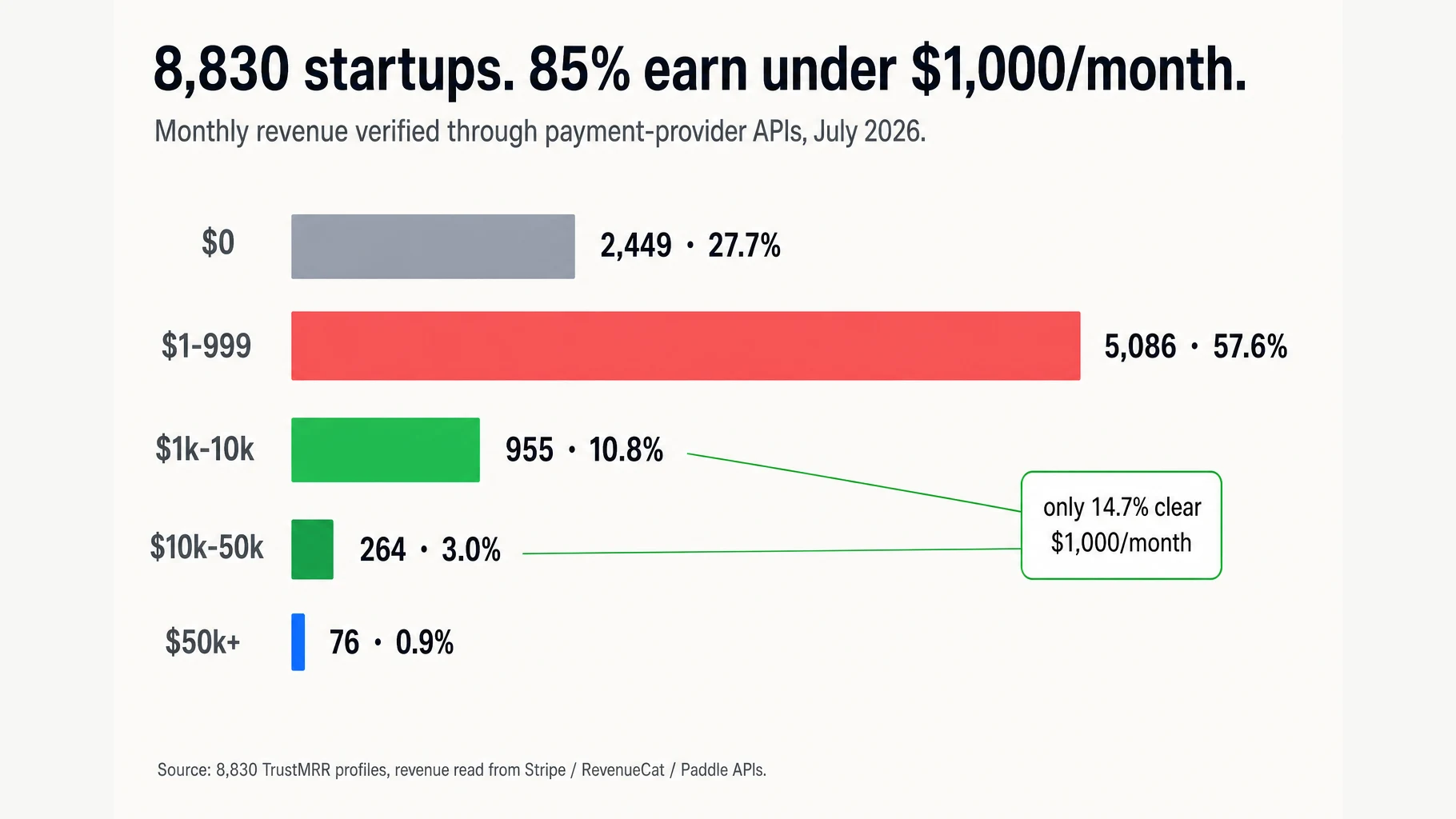
Fair warning before the list: the same dataset says 85.3% of these startups earn under $1,000 a month. The ideas are real. The odds are still the odds. Both halves are in this article.
8,830
Startups, revenue API-verified
15
Niches with repeat proof
$3,484
Median of those that work
85.3%
Earn under $1,000/month
How a niche earned its place on this list
A niche only qualified if it cleared all four bars:
- At least two independent founders earning $1,000–$50,000/month from the same underlying idea. One company is an anecdote; the pattern is the signal.
- Verified revenue, read from the payment processor, currently live — not a screenshot, not a claim, not a peak from two years ago.
- Reachable without authority. Most examples sit under DR 30, several under DR 10. If a niche only worked for established domains, it is not an idea, it is a moat someone else owns.
- Buildable alone. No marketplace liquidity problems, no hardware, no regulated custody of money.
We excluded crypto, gambling and pure entertainment, and we discarded 89 "collapsed" startups that once passed $1,000/month and now earn nothing — those are used as anti-signal rather than proof.
The 15 ideas at a glance
| # | Idea | Proof points | Best verified example | Lowest DR that works |
|---|---|---|---|---|
| 1 | Certification exam prep | 4 | Tree Nerd Academy — $37,253/mo | DR 1 |
| 2 | Government paperwork & visas | 5 | NDISCompliant — $13,986/mo | DR 1 |
| 3 | Platform companion tools | 4 | Notionlytics — $37,815/mo | DR 18 |
| 4 | Legacy / niche API wrappers | 3 | Conductor — $36,148/mo | DR 10 |
| 5 | Buying-intent lead alerts | 3 | Groups Watcher — $23,454/mo | DR 3 |
| 6 | Job-application automation | 4 | Lancer.app — $24,446/mo | DR 2 |
| 7 | Reseller & cross-listing ops | 3 | DropPop — $27,797/mo | DR 22 |
| 8 | AI product photography | 3 | Refined Listings — $19,040/mo | DR 0 |
| 9 | Vertical translation | 2 | Glossa.live — $21,436/mo | DR 27 |
| 10 | Faith & church tooling | 3 | Glossa.live — $21,436/mo | DR 3 |
| 11 | Long-form → short-form video | 3 | Taja AI — $18,885/mo | DR 0 |
| 12 | AI visibility / AEO tracking | 3 | SEO STACK — $25,670/mo | DR 15 |
| 13 | Store-ops tooling | 3 | Plutocracy — $9,775/mo | DR 1 |
| 14 | Curated database as a product | 2 | Angel Match — $25,001/mo | DR 39 |
| 15 | Social content for one profession | 3 | Marky — $22,548/mo | DR 5 |
Revenue is verified 30-day or timeline-median, July 2026. "Lowest DR that works" is the weakest domain in that niche still earning $1,000+/month.
Group A — Sell to someone with a deadline
The single strongest pattern in the whole dataset. When the buyer has a date on the calendar or a legal obligation, price resistance collapses and you never have to manufacture urgency.
1. Certification exam prep — pick exactly one exam
Not "test prep". One credential, owned completely: video lessons, a question bank, flashcards. The buyer has already paid an exam fee and booked a date. Every professional field has a certification nobody has built decent software for.
Proof: Tree Nerd Academy $37,253/mo on DR 7 with 99 followers, teaching only the ISA Certified Arborist exam · WRITING9 $5,478/mo (IELTS essay scoring) · Francopass $2,085/mo on DR 1 (French naturalisation interview) · Prep For Certs $1,515/mo (IT certifications)
Why it's open: the incumbents are Quizlet decks and 2009-era PDF sites. Long-tail search around "[certification] practice test" is unusually weak.
2. Government paperwork, permits and visas
One mandatory, jurisdiction-specific form, wrapped in software that doesn't hate the user. Your competitor is a government website, which will never out-design you and never runs ads.
Proof: NDISCompliant $13,986/mo on DR 7 (Australian disability-scheme compliance) · Easy Moving Permits $7,612/mo on DR 6 (city street permits) · Snap2Pass $5,070/mo (compliant passport/visa photos) · Get Brazil Visa $3,689/mo on DR 5 (digital-nomad visa) · Passport Photo Ready $2,162/mo on DR 1
The strongest low-authority niche in the dataset: median DR 6.5, and every single founder has under 2,000 followers.
3. Job-application automation
Job hunting is a deadline with anxiety attached, and the buyer is spending to end it. The winners here are narrow: not "career platform" but "auto-respond to Upwork jobs" or "tailor this CV to this posting".
Proof: Lancer.app $24,446/mo on DR 15 with 68 followers (automates Upwork applications) · U Never Sleep $5,042/mo on DR 2 (Upwork auto-responder) · SPRINTJOB $4,717/mo on DR 2 · Oaki $4,425/mo (AI recruiter for job seekers)
Median DR of just 3 across the group, and 100% of founders under 2,000 followers — the most accessible niche on this list.
Group B — Attach yourself to a platform
Let somebody else own the customer relationship and the distribution. You supply the part they refuse to build.
4. Platform companion tools
Ship the one obvious feature a big platform won't. Discovery comes from the host's app directory instead of from you, which is why founders with no audience can win here.
Proof: Notionlytics $37,815/mo (page analytics for Notion) · Karma $24,612/mo with 79 followers (recognition for Slack/Teams) · Meet For Slack $4,450/mo (one button, one job) · Superpower for AI $2,628/mo (Chrome extensions for AI chat tools)
The risk is real: the host can ship your feature. Meet For Slack is a reminder that "trivially simple" is not the same as "not worth money".
5. Legacy and niche API wrappers
Wrap a hostile, ancient or fragmented API that is business-critical and miserable to integrate. You are selling developers the right to never touch it.
Proof: Conductor $36,148/mo on DR 10 — literally "the best QuickBooks Desktop & Enterprise API on the planet" · Apiframe $29,759/mo (one API for many AI models) · Socialcrawl $12,532/mo on DR 10 (one API across 24+ social platforms)
Highest median revenue of any niche here at $29,759/mo. Also the highest skill bar — this one rewards engineers specifically.
6. Store-ops tooling for one commerce platform
Bulk listing, funnels, catalogue import — unglamorous operational work for merchants who are already paying for software and already making money.
Proof: Plutocracy $9,775/mo on DR 1 (Shopify marketing funnels) · Catalister $6,864/mo on DR 16 (bulk product import to Shopify) · Leadbomb $3,808/mo on DR 4
Every founder in this group is under 2,000 followers, and the median DR is 4. Merchants find you in app stores, not on Google.
Group C — Sell intent, data and visibility
Nobody is buying software here. They are buying a lead, an answer, or a place in a ranking — which is why these tolerate high prices and thin feature sets.
7. Buying-intent lead alerts
Watch a public forum for people asking to buy something, and tell a business that sells it — fast. You are selling speed, not features.
Proof: Groups Watcher $23,454/mo on DR 6 with 75 followers, alerting tradespeople to Facebook-group leads within 60 seconds · NextjobConnect $7,932/mo on DR 3 with zero followers (monitors neighbourhood platforms for home-service jobs) · TruckerDB $1,484/mo (DOT carrier leads and insurance renewals)
Pick a trade where one job is worth hundreds and the buyer is a small business owner refreshing Facebook at 9pm.
8. A curated database, sold as a product
Assemble a list that is genuinely painful to compile, keep it current, and charge for access. The work is the moat: anyone can copy the idea, nobody wants to maintain the rows.
Proof: Angel Match $25,001/mo — a database of 124,000 angels and VCs · JobBoardSearch $2,652/mo — a meta-directory of job boards
Caveat: the highest-authority group here (median DR 56.5). These grow through search, so expect a slower start than the platform-native niches. This is the pattern most directory businesses are built on.
9. AI visibility / AEO tracking — hot, and filling fast
Track whether a brand gets mentioned by ChatGPT, Gemini and AI Overviews, and tell them how to fix it. Real budget is moving here because everyone's SEO reporting suddenly has a hole in it.
Proof: SEO STACK $25,670/mo · ReddGrow AI $13,815/mo on DR 15 (Reddit + AI-search visibility for B2B) · AIRIX $1,825/mo on DR 22
Flagged amber deliberately: this is the most crowded niche on the list and the one most likely to be commoditised. Enter with a specific vertical, not a general dashboard.
Group D — Point AI at one specific job
"AI tool" is not a business. "AI that does this exact expensive task for this exact buyer" repeatedly is.
10. AI product photography
Replace a photoshoot. The buyer has a concrete alternative that costs hundreds or thousands, which makes the pricing conversation trivial.
Proof: Refined Listings $19,040/mo on DR 0 with zero followers (virtual staging for real-estate agents) · Photta $15,859/mo (fashion and jewellery brands) · Rewarx $4,888/mo (e-commerce batch processing)
Refined Listings is the single most striking data point in the dataset: a DR 0 domain, no social presence, $19k/month, twelve straight months.
11. Long-form → short-form video repurposing
One podcast or webinar becomes thirty clips. Crowded on the surface, but the winners all narrowed: a platform, a format, or a customer type.
Proof: Taja AI $18,885/mo with zero followers (SMB long-form repurposing) · Rotgen.org $6,750/mo on DR 0, zero followers · StoryHero $4,139/mo on DR 18, zero followers
Median founder follower count in this group: zero. Whatever is working here, it isn't personal brand.
12. Vertical translation and localisation
Not general translation — translation for one setting with its own vocabulary, latency needs and buyers. Live events, websites, media.
Proof: Glossa.live $21,436/mo on DR 39 with 79 followers — real-time translation for churches at $5/hour · GlobalSeo $5,896/mo on DR 27 (AI website translation)
94% of founders in the wider translation group are under 2,000 followers.
Group E — Serve one community properly
Pick a group that big software ignores, and become the obvious answer inside it. Distribution is word of mouth, which compounds and costs nothing.
13. Faith and church tooling
Hundreds of thousands of congregations, real budgets, almost no modern software, and referral networks that spread a working tool fast.
Proof: Glossa.live $21,436/mo (live sermon translation) · Sermon Scribe $14,317/mo on DR 3 with zero followers (record, transcribe, summarise) · DivineTV $11,230/mo (Christian streaming)
Highest median revenue of any community niche here at $12,774/mo, and every founder is under 2,000 followers.
14. Reseller and cross-listing operations
People selling across eBay, Depop, Vinted, Etsy and Facebook Marketplace do the same tedious work every day. They are running a business and will pay to keep it running.
Proof: DropPop $27,797/mo (automates listings across Depop, Vinted, Etsy, eBay) · Flipify $15,346/mo on DR 22 with 36 followers (deal-finding across marketplaces) · DodgePrint $10,289/mo (multi-channel listing management)
Every founder here is under 2,000 followers. These sell inside reseller communities, not on Google.
15. Social content for one profession
Generic social schedulers are a bloodbath. Scheduling built around the vocabulary and rhythm of a single profession is not.
Proof: Marky $22,548/mo with 64 followers — social media specifically for self-publishing authors · Draft AI $20,963/mo (voice notes → posts) · Esferas.io $16,103/mo on DR 5 with zero followers (LinkedIn automation)
Marky is the template: same feature set as a hundred dead competitors, one clearly named customer.
Now the part idea lists leave out: your actual odds
Every niche above is real. Most people attempting them will still not make money. Here is the same dataset, unfiltered.
Monthly revenue distribution — all 8,830 startups
Verified via payment-provider API, July 2026
Bars scaled to the largest band. 1,295 startups (14.7%) clear $1,000/month.
27.7% earn exactly nothing. They connected live billing and it has processed no money at all. Another 57.6% sit between $1 and $999. And ten companies — led by Gumroad at roughly $7.5M/month — hold half of all revenue in the dataset, which is why any "average micro SaaS revenue" figure that doesn't drop the top ten is really telling you about Gumroad.
Set your target at $3,484/month, the median of the startups that actually work. Not $10,000 — that band is about 3.9% of the dataset.
Do you need an audience? Not really — but it helps more than people admit
The popular claim is that the median founder earning $1k+ has just 114 followers, therefore audience is irrelevant. The number is true; the conclusion is backwards. Most entrants have small audiences too. The real question is what share of each group made it.
Odds of reaching $1,000/month, by founder follower count
Share of all entrants in each bucket that cleared $1,000/month
From 1–99 followers up to 100k+, the odds run 9.7% → 45.5%. An audience is worth roughly a 4.7x improvement in your chance of reaching $1,000/month. Anyone claiming it doesn't matter is reading the numbers backwards.
And yet 73.7% of everyone who got there had fewer than 1,000 followers. The audience-free path isn't just viable, it's the majority path — because that's who's playing. Which is exactly why the niches above are filtered for founders starting from zero.
Which categories actually pay
| Category | Entrants | Hit rate | Median winner rev |
|---|---|---|---|
| Marketplace | 97 | 24.7% | $7,473 |
| Mobile apps | 535 | 20.9% | $5,715 |
| Ecommerce | 167 | 20.4% | $5,428 |
| Education | 361 | 19.4% | $2,946 |
| Marketing | 487 | 18.7% | $5,867 |
| AI | 1,927 | 15.7% | $3,538 |
| SaaS | 858 | 11.7% | $4,838 |
| Developer tools | 526 | 11.6% | $2,891 |
| Analytics | 239 | 11.3% | $9,253 |
| Productivity | 620 | 6.3% | $2,734 |
Productivity is the trap — 620 attempts, 39 winners. It's the category everyone builds for themselves, competing against free and excellent tools. AI is crowded but fine: 1,927 entrants and a 15.7% hit rate, slightly above the 14.7% average. Being "AI" is table stakes now, not a differentiator. Analytics pays best per winner ($9,253 median) on some of the worst odds.
The channels that correlate with money
TrustMRR publishes a top-30 list per marketing channel — roughly 30 startups each, so treat this as directional. The spread is still striking:
SEO tops the table at $17,704 median revenue, and its median founder has zero followers. Then word of mouth ($17,567), content marketing ($12,615) and Google Ads ($12,059). At the bottom: Product Hunt, at $1,733 — a tenth of SEO, and the fewest winners of any list. A launch is an event, not a distribution channel.
The top four all put your product in front of someone already looking for it. The bottom of the table is full of channels where you interrupt someone who isn't.
How to actually choose one
- Pick the buyer before the product. Every winning niche above has a buyer with a deadline, a legal obligation, or a job that's blocked today.
- Require two competitors, not zero. A niche with no one charging for it usually has no one paying for it. Competition is proof of payment.
- Check the DR floor. If everyone ranking is DR 50+, you're signing up for a two-year SEO project. Several niches above have proof at DR 0–7.
- Prefer platform-native distribution if you have no audience — app directories, marketplaces and communities let you skip the authority problem entirely.
- Give it eighteen months. The median winner is 15.5 months old; 39.4% got there inside a year. Judging at month four is judging before the data says anything.
Method, and what this data cannot tell you
We fetched every public startup profile on trustmrr.com in July 2026 (8,830 profiles, agent-readable .md endpoints, rate-limited) and parsed 25 fields each. Where a payment sync was more than 60 days stale, we fall back to the median of recent non-zero months rather than trusting the headline figure. 89 "collapsed" startups — once above $1,000/month, now near zero — are excluded from niche selection and used as anti-signal. Niches were found by keyword and bigram clustering over the clean in-band pool, then verified company-by-company by hand.
Five things this data genuinely cannot tell you
- The sample is self-selected. Founders opt in to TrustMRR, which skews indie and Stripe-economy. Agencies, enterprise software and anything not billed through a supported processor are invisible. "85% earn under $1,000" describes this population, not all software businesses.
- Revenue is not profit. A consumer app doing $20,000/month on paid ads may take home less than a $5,000/month B2B tool. There is no cost data here at all.
- These niches are proven, not guaranteed. Evidence that several people make money in a category is not evidence that you will. Execution, timing and distribution still decide it.
- Follower counts are X only, and measured today. Some "large audience" founders built the audience after the revenue, which flatters the correlation.
- Correlation, not causation. DR, followers and channel all run both ways — money buys authority and attention as readily as the reverse.
Crypto, gambling and entertainment were excluded by design. Domain Rating was available for 6,959 of 8,830 startups; DR-based percentages use that subset.
Data pulled July 30, 2026. Revenue figures are 30-day verified or timeline-median estimates in USD per month. For how the underlying directory works, see our breakdown of TrustMRR.
📊 One of these niches, taken apart, every issue
We're working through this list one company at a time — pricing, positioning, where the customers actually come from, and what you could copy. Next up: Tree Nerd Academy, $37,253/month on a DR 7 domain.
Get the next teardown
Frequently asked questions
What is a micro SaaS?
A small software product, usually built and run by one person or a tiny team, that serves a narrow niche rather than a broad market. It is typically bootstrapped, subscription-billed, and profitable at a scale that would be considered a failure for a venture-funded company — a few thousand dollars a month is a good outcome.
What are the best micro SaaS ideas for 2026?
Based on 8,830 payment-verified startups, the niches with the strongest evidence are: certification exam prep for a single exam, government paperwork and visa automation, platform companion tools, legacy API wrappers, buying-intent lead alerts, job-application automation, reseller cross-listing tools, AI product photography, vertical translation, faith and church tooling, video repurposing, AI visibility tracking, store-ops tooling, curated databases, and social content for one profession. Each has multiple independent founders earning $1,000 or more a month.
How much money does a micro SaaS actually make?
Across 8,830 startups with payment-provider-verified revenue, 85.3% earn under $1,000/month and only 14.7% clear it. Among the 1,219 earning between $1,000 and $50,000/month, the median is $3,484/month. Treat $3,484 as a realistic target, not the $10,000/month figure usually quoted.
Do you need an audience to build a micro SaaS?
No, but it helps more than people admit. Founders with under 100 followers reached $1,000/month 9.7% of the time; founders with 100,000+ followers did so 45.5% of the time — roughly a 4.7x advantage. Yet 73.7% of everyone who reached $1,000/month had fewer than 1,000 followers, because that is who is playing. An audience is a real edge, not a prerequisite.
How do you find a micro SaaS idea?
Look for a buyer with a deadline or a legal obligation — an exam date, a permit due, a lead going cold, a platform gap blocking work today. Every one of the 15 validated niches has one. Then check whether at least two independent people are already charging for it: competition is proof of payment, and a niche with zero competitors usually has zero buyers.
Which micro SaaS categories have the best odds?
By share of entrants clearing $1,000/month: marketplace 24.7%, mobile apps 20.9%, ecommerce 20.4%, education 19.4%, social media 19.2% and marketing 18.7%. Productivity is the worst at 6.3%. AI is the most crowded with 1,927 entrants and a middling 15.7% hit rate.
Related Case Studies
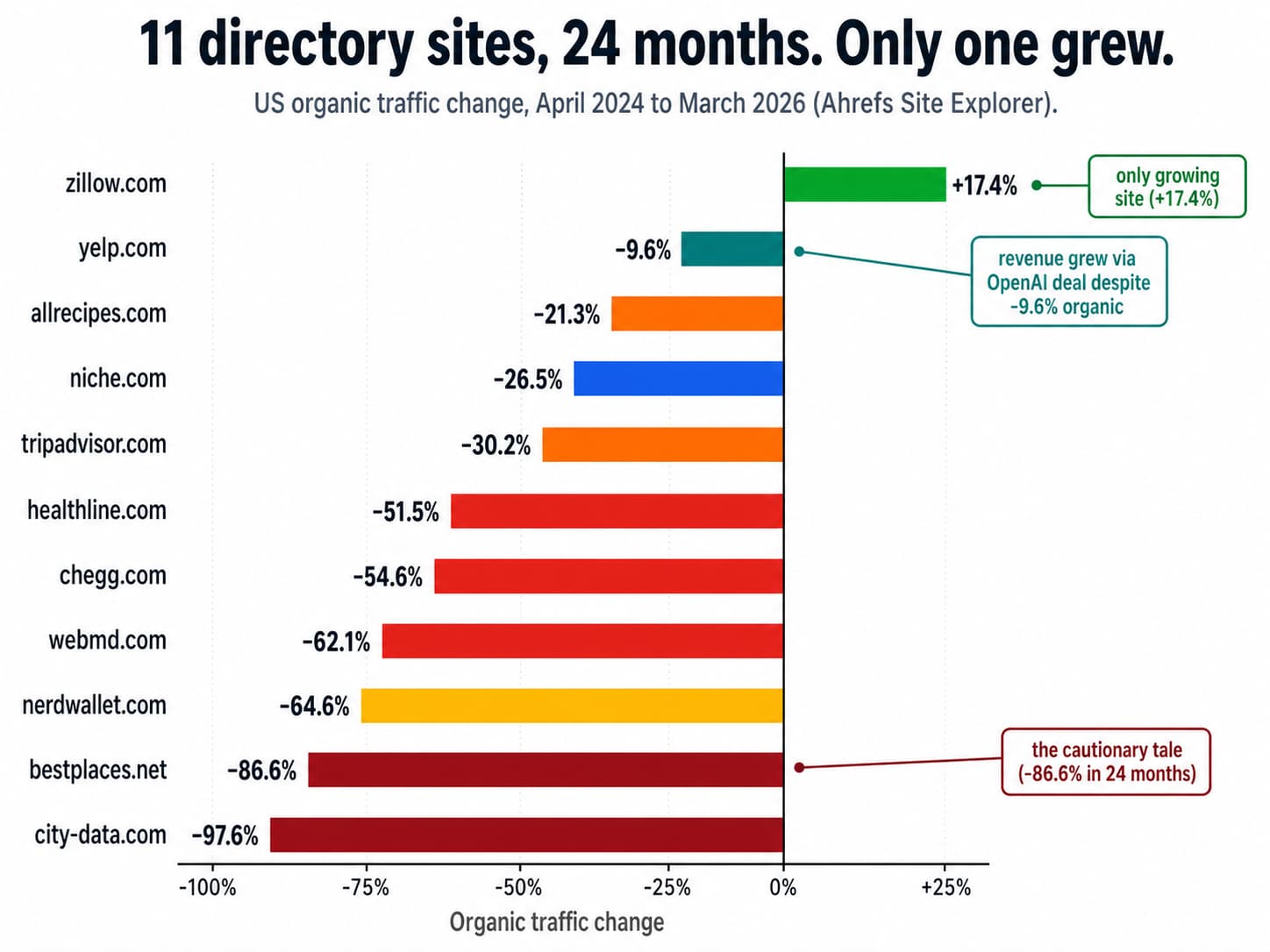
Of 11 directory sites audited against Ahrefs in April 2026, only Zillow grew. Two-thirds lost 21–98%. Six repeatable patterns separate winners, decoupled survivors, and dying directories.
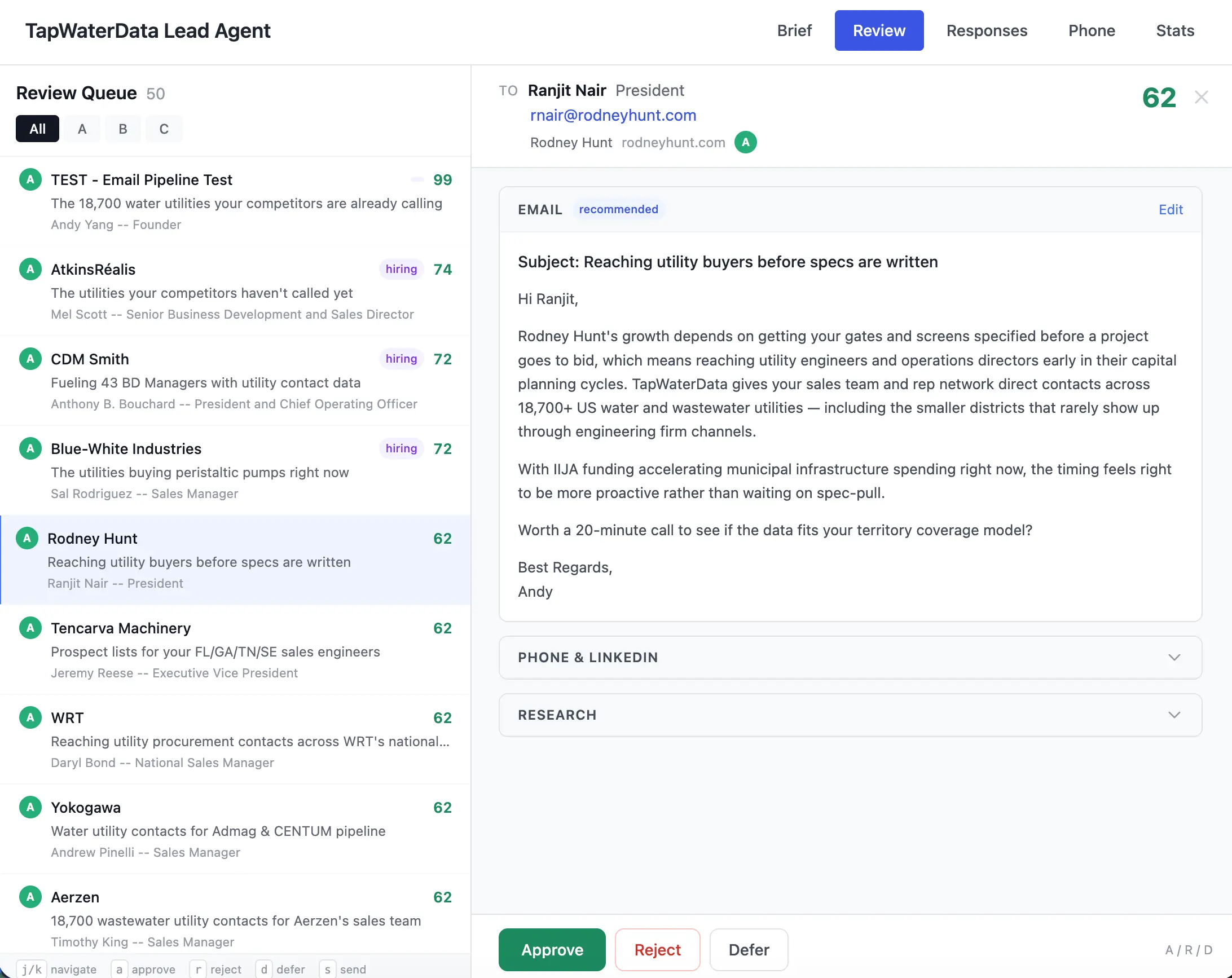
I described what I wanted and Claude Code built an 8,800-line AI sales agent in one session. 665 prospects, 60% open rate, $27/week. Here's the full breakdown.
How Basecamp's founders turned their expertise in remote work into the largest remote job board—from the company that wrote the book on working remotely.
How two developers who met on Twitter turned a $1,000 investment into the world's largest beer discovery platform—working nights and weekends for five years before going full-time.